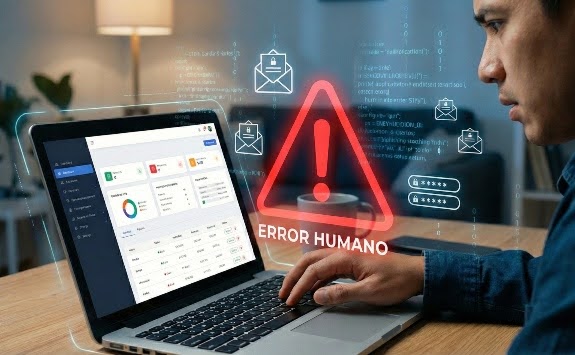
Cybersecurity is one of those issues we all know we should be taking care of, but we keep putting it off. Updating passwords, checking permissions, verifying links… These are simple tasks, yes, but they’re often overlooked. And that’s precisely the root of the problem: In cybersecurity, the human factor remains the weakest link.
This isn’t about blaming anyone, but about acknowledging an apparent reality. Human error is, currently, the most common cause of digital incidents.
In recent years, the rise of remote work, the fast pace of life, and the daily use of connected devices have made this vulnerability even more pronounced. And if we think about it for a moment, it makes sense: an impulsive click or a weak password can open the door to problems that cost time, money, and reputation.
Before moving on, it’s worth introducing a tool that’s helping to reduce this exposure in the daily lives of all users: Qondar, Enthec’s cyber-surveillance solution for individuals. Qondar is a key component of Continuous Threat Exposure Management, providing timely warnings about data breaches, password leaks, and other risks that directly affect a person’s digital life.
Understanding the relationship between cybersecurity and the human factor
The expression “cybersecurity and the human factor” encompasses a straightforward idea: Digital security does not depend solely on systems, firewalls, or artificial intelligence,but also on how we use technology. Companies can invest in advanced tools, but they’re of little use if an employee falls for a phishing email or unintentionally shares sensitive information.
Why do we keep failing at the same things?
Several reasons explain this phenomenon:
- Information overload. We live surrounded by notifications and simultaneous tasks. In that pace, double-checking a suspicious email isn’t always a priority.
- Overconfidence. In both our professional and personal lives, we often think, “It won’t happen to us.” But no one is safe: neither individuals nor companies.
- Lack of ongoing training. Many attacks evolve so rapidly that what we knew a year ago is no longer sufficient. And this is where the CTEM concept comes into play.
The importance of Continuous Threat Exposure Management (CTEM)
Cybersecurity can no longer be viewed as a one-off project. It’s not enough to conduct a single audit and assume everything is under control. Threats evolve. Data moves. And attackers refine their techniques.
Continuous Threat Exposure Management (CTEM) seeks precisely this: to constantly monitor which vulnerabilities we have and which risks are active at any given time. . It’s not just about reacting, but about detecting before the damage occurs.
What does CTEM contribute to the field of human factors?
- Constant visibility: allows you to see if leaked credentials, breaches, or risk signals associated with common errors have appeared.
- Realistic prioritization: It helps determine which vulnerabilities require immediate attention and which do not.
- Data-based prevention: The sooner a problem is identified, the easier it is to correct.
This is where solutions like Kartos (for businesses) and Qondar (for individuals) play an instrumental role. Both allow this continuous exposure approach to be implemented without complex processes or specialized equipment.
Most frequent human errors in cybersecurity
Below are some of the most common mistakes in both the business and personal spheres. All of them are directly related to cybersecurity and the human factor, and many could be avoided with minimal monitoring or training.
1. Reusing passwords
A classic. According to a NordPass study, most users still reuse the same password across more than 10 different services. If one of those platforms suffers a data breach, they are all exposed.
You may be interested in→ How to manage business passwords and credentials easily and securely to avoid online threats.
2. Falling for fraudulent emails or messages
Phishing is becoming increasingly sophisticated. Many attacks perfectly mimic well-known companies, banks, or even coworkers. An innocent click can compromise the entire device.
3. Underestimating “harmless” information
Sometimes we share seemingly irrelevant data: a photo with location, a personal email on a website without HTTPS, an automatic response on vacation… All of that can be useful to an attacker.
4. Trusting open Wi-Fi networks
Having a coffee while we work is tempting, but connecting to an open network can expose sensitive information to third parties.
5. Failure to monitor personal data leaks
Many users are unaware whether their credentials have been exposed on forums, in leaked databases, or on the dark web. This lack of control fuels risks that accumulate without us even realizing it.
How to reduce human vulnerability: habits and tools
The good news is that improving cybersecurity and the human factor doesn’t require being an engineer or dedicating hours every week. Often, simple measures are enough.
Basic digital hygiene
- Use unique and strong passwords.
- Activate two-step verification.
- Be wary of unsolicited links or files.
- Review application permissions.
- Keep systems updated.
Continuing education in companies
It’s not just about giving an annual talk. Organizations that reduce incidents typically implement short, dynamic, and frequent training sessions. Even small reminders have a real impact.
Cyber surveillance for individuals
This is where Qondar comes in, designed so that anyone can:
- Find out if passwords have been leaked.
- Detect digital identity theft.
- Monitor mentions or data in high-risk areas.
- Receive clear and actionable notifications.
It’s a simple way to effortlessly integrate the CTEM mindset into your daily routine, helping to make the human factor no longer a permanent problem.
Technology helps, but the responsibility is shared.
Although tools like Kartos or Qondar facilitate risk management, cybersecurity remains a shared responsibility. The sum of human behavior and technological surveillance is what truly builds a safe environment.
The key is to create a culture where asking questions, checking, and being skeptical are the norm, not the exception, where it’s understood that a mistake isn’t a personal failing, but a reminder that we are all vulnerable.
The relationship between cybersecurity and the human factor is undeniable. As long as distractions, overconfidence, and a lack of healthy digital habitsexist, incidents that could have been avoided will continue to occur. That’s why it’s so important to integrate continuous monitoring at both the company and individual levels.
If you want to improve your personal protection,whether it’s your own data or that of your close circle, Qondar is an accessible, practical option that lets you see what’s happening with your data in real time. Discover our tool and start controlling your digital exposure today. More conscious cybersecurity is just a step away.