Cybersecurity has been evolving for years at a pace that is sometimes difficult to keep up with. Threats change, attack methods become more subtle, and the amount of information we manage continues to grow.
Amid this scenario, one factor remains decisive: the human error,. not out of ill intent, but because we humans can’t be aware of everything, all the time. Fortunately, cybersecurity automation has become an ally that helps us strengthen protection without adding complexity to daily life.
Before delving into the subject, it’s worth pausing to consider a tool that perfectly encapsulates this evolution. We’re discussing Qondar, Enthec’s solution designed for individuals who want to manage their exposure to digital risks.. Its practical, visual, and continuous approach reveals where the sector is heading: constant monitoring, clear warnings, and the ability to make informed decisions without needing a master’s degree in cybersecurity.
In short, Qondar shows how automation can be close, practical, and, above all, accessible.
Why human error remains one of the most significant security breaches
Most security incidents are not due to complex failures in highly advanced systems, but to everyday actions such as opening a suspicious email, reusing passwords, or downloading a file without thinking.
This makes sense; whoever attacks finds the easiest way to access a system,and we humans are often that weak point. While training is essential, relying solely on human attention isn’t sufficient, especially in environments where we receive hundreds of notifications, messages, and tasks vying for our attention.
This is where cybersecurity automation becomes essential. It’s not about replacing anyone, but about minimizing unavoidable oversights by delegating repetitive tasks, from surveillance and analysis to systems that do not get tired, do not get distracted, and do not forget.
How automation strengthens online protection
Automated cybersecurity is not an abstract or futuristic concept. It’s already being implemented in companies large and small, and increasingly in solutions for individual users.. Here are some of the areas where it has the most significant impact:
1. Continuous, uninterrupted monitoring
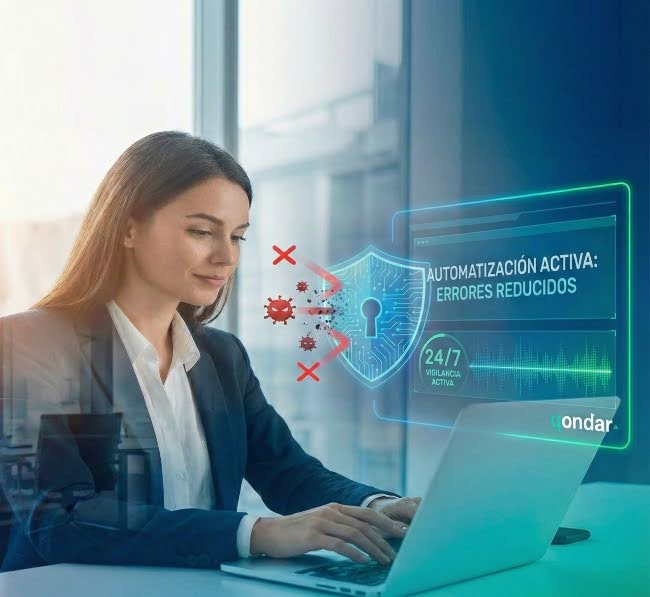
An automated system can monitor in the background 24/7, detect unusual patterns, and provide instant alerts. This type of monitoring would be impossible if it depended solely on a person. Furthermore, it allows for anticipating attacks before they fully materialize.
At this point, automation in cybersecurity acts as a radar that never turns off.
2. Reduction of repetitive and error-prone tasks
Checking links, validating emails, verifying configurations, comparing databases… These are necessary tasks, but they are also precisely the type of processes where errors can occur due to fatigue or simple saturation.
Automating them is doubly beneficial:
- Time is gained.
- It prevents an oversight from turning into a bigger problem.
3. Incident classification and prioritization
One common problem is the number of alerts generated each day. Without automation, many go unnoticed or are addressed late. With advanced tools, incidents are ordered by severity, allowing us to react sooner where it really matters.
4. Updates and patches without manual intervention
An essential part of security is keeping everything up to date.. Automation saves headaches here, too. A self-updating system reduces risks without requiring additional time.
CTEM: the new approach that unites surveillance and automation
In recent years, the concept of CTEM (Continuous Threat Exposure Management) has gained traction.. It is not a fad or an empty word; it is a methodology that combines continuous evaluation, risk prioritization, external and internal visibility, and agile response.
Essentially, CTEM applies automation in cybersecurity to keep under control what can be compromised, how, and with what level of urgency.
Enthec’s solutions, Kartos, focused on businesses, and Qondar,designed for individuals, are a clear example of this philosophy. Both monitor in real time, detect leaks or exposures, and display information clearly so that each person can make decisions based on real, up-to-date data.
The importance of automating personal cyber surveillance
When we think about digital threats, we usually picture companies, large organizations, or critical infrastructure. However, individual users are increasingly becoming targets, not because we hold big secrets, but because we accumulate data, access credentials, and accounts that attackers can exploit.
What kind of risks do we avoid with automation?
- Password leaks in external services.
- Appearance of personal data in leaks.
- Identity theft on social networks.
- Suspicious access from unusual locations.
- Involuntary disclosure of private information.
Qondar automates this surveillance and provides clear, understandable notices for everyone. . You don’t need to be a cybersecurity expert to recognize the risk and take action.
You may be interested in→ 9 healthy digital habits that will protect you from identity theft and leaks.
Automation doesn’t mean disengagement; instead, it means making better decisions.
It’s important to clarify that automating security doesn’t mean “putting everything on autopilot,” but rather ensuring that essential alerts don’t go unnoticed,. while maintaining a balance between technology and human judgment.
The ideal combination is:
- Automation for monitoring, classifying, and alerting.
- The person to make the final decision.
This alleviates the mental burden and enables stronger protection without requiring additional time.
Real advantages of automation in cybersecurity for businesses and individuals
Although the contexts are different, both companies and individual users can benefit from a user-based approach to automation in cybersecurity:
For companies
- Fewer errors resulting from manual processes.
- Greater visibility over the attack surface.
- Early detection of exposures in equipment, employees, or suppliers.
- Optimization of IT department resources.
For individuals
- Absolute control over one’s digital footprint.
- Clear, actionable alerts without technical jargon.
- Continuous security without relying on remembering to check.
- Ongoing updates to address new threats.
Automation is about better protection, not more complexity.
Automation does not replace human care, but it does add a layer of precision and consistency that is hard to match.. In an environment where cybercriminals automate their attacks, it is logical to respond with tools that can monitor at the same scale.
If you genuinely want to understand your digital exposure, receive early warnings, and improve your personal security without complications, Qondar by Enthec is a good starting point. If your company needs more comprehensive oversight, Kartos offers a level of depth designed for organizations.
Start protecting your online identity today.
Try Qondar and discover how cybersecurity automation can give you continuous, precise monitoring tailored to your daily life.. Your digital peace of mind starts with a click.