In any organization, there are accounts that have more power than others—those that can access critical systems, modify sensitive settings, or move large volumes of data. These are known as privileged access, and protecting them is one of the biggest challenges in cybersecurity today. This is where PAM really comes into its own.
What is PAM in cybersecurity?
PAM stands for Privileged Access Management. It refers to a set of strategies, policies, and technological tools designed to control, monitor, and audit access to an organization’s most sensitive resources and what can be done with them.
In cybersecurity, PAM is the discipline that ensures only the right people have access to critical systems, at the right time, and with only the strictly necessary permissions.
We’re not just talking about internal employees. Privileged access also includes external vendors, automated applications, software bots, and cloud system administrators. The scope is much broader than it appears at first glance.
Why privileged access is a top target for attackers
Malicious actors know this all too well: if they manage to gain access to a privileged account, they hold the keys to the kingdom. According to the report 2025 Verizon Data Breach Investigations Report, the use or misuse of credentials remains the most common attack vector in security breaches analyzed globally.
That explains why stealing privileged credentials is so lucrative for attackers and, therefore, such a top priority for security teams. An employee with administrator access whose password is compromised can cause a disaster in minutes.
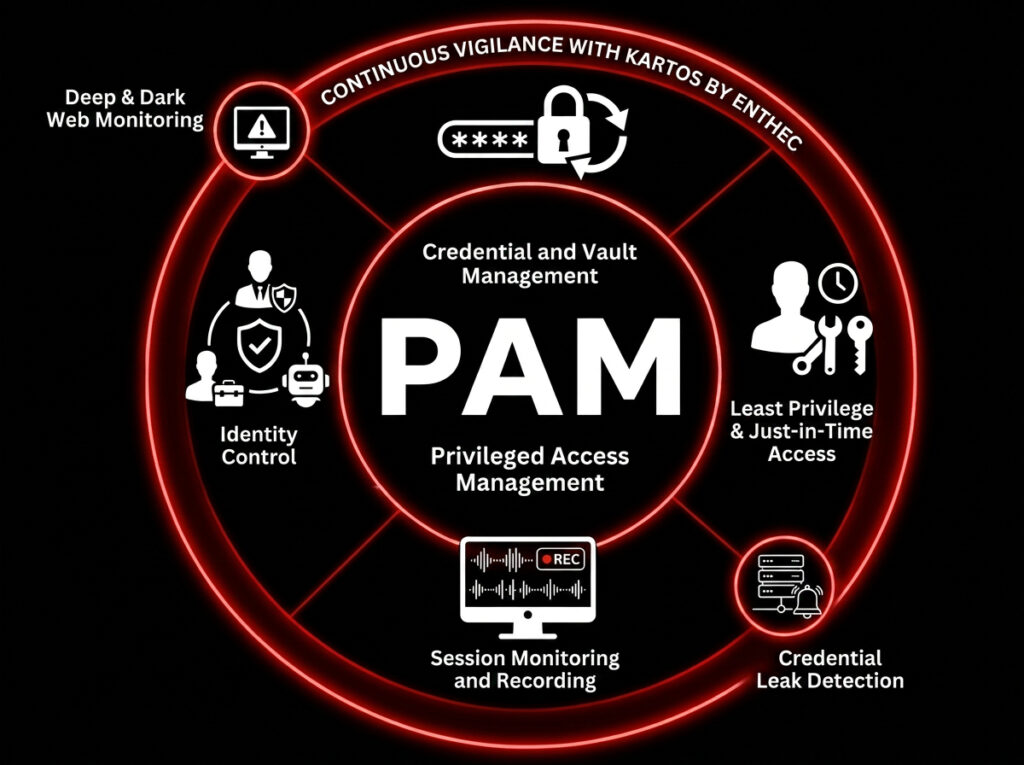
What’s included in a PAM solution
When we talk about PAM in cybersecurity, we are not referring to a single tool, but rather to a set of elements that work together in a coordinated manner.
Privileged Password Management
PAM solutions include password vaults (password vaults) that automatically store and rotate privileged account credentials. This prevents the same password from being reused for months or even years—a practice that, unfortunately, remains all too common.
You might be interested in:> How to manage business passwords and credentials easily and securely to avoid online threats
Least-privileged access control
One of the fundamental principles of PAM is the so-called principle of least privilege (least privilege): Each user or process should have only the permissions necessary to perform their work. Nothing more.
This approach drastically reduces the attack surface. If a compromised account has access only to a specific system, the potential damage is contained.
Session monitoring and recording
Another key feature of PAM in cybersecurity is the ability to monitor privileged sessions in real time and even record them. This is essential both for detecting anomalous behavior and for complying with regulatory requirements such as the GDPR, the ENS, or industry-specific standards like PCI-DSS.
Multifactor authentication and access just-in-time
The most advanced solutions incorporate multi-factor authentication (MFA) for privileged access and enable the implementation of ajust-in-time access model, in which permissions are granted only when needed and automatically revoked once the task is complete.
PAM is essential to your company’s security strategy
Implementing PAM in cybersecurity is not simply a matter of adding another technical layer. It involves adopting a control model that directly impacts the organization’s overall security posture.
Internal risk reduction
Not all security incidents originate from outside the organization. Employees or contractors with privileged access—whether intentionally or by mistake—pose a real risk. PAM enables the implementation of controls that reduce the likelihood of accidental or deliberate misuse having serious consequences.
Compliance
Many regulatory frameworks and security standards require specific controls for privileged access. Having a well-implemented PAM solution greatly facilitates audits and regulatory compliance with standards such as ISO 27001, the National Security Scheme, and SOC 2.
Complete visibility into critical access points
One of the common problems in organizations without a defined PAM strategy is a lack of visibility; it is unclear who has access to what, when, or from where. This lack of transparency creates an environment where problems can go unnoticed for months.
PAM addresses this blind spot by providing full traceability of all transactions involving privileged accounts.
PAM and Continuous Threat Exposure Management
PAM does not operate in isolation. To be truly effective, it must be integrated into a broader security strategy that maintains continuous visibility into external threats.
This is where solutions like Kartos by Enthec add unique value. Kartos is a platform for Continuous threat exposure management designed for businesses, which continuously monitors the organization’s exposure in open sources, the deep web, and the dark web.
For example, it detects whether the company’s privileged credentials have been leaked or are circulating on underground forums before an attacker can exploit them.
That combination (PAM and CTEM) is what enables organizations to take a truly proactive approach to security rather than merely reacting after the damage has already been done.
The Most Common Mistakes When Implementing PAM in Cybersecurity
Implementing a PAM strategy isn’t always easy. There are common mistakes you should be aware of to avoid them.
- Failing to properly inventory privileged accounts. Before you can secure anything, you need to know what you have. Many organizations are unaware of the actual number of active privileged accounts, especially those associated with automated applications or services.
- Failure to inspect access points on a regular basis. Permissions tend to accumulate over time. An employee who changes roles may retain access privileges they no longer need. Without regular reviews, the problem grows unnoticed.
- Treat the PAM as a one-off project. Privileged access management isn’t something you set up once and forget about. It requires ongoing maintenance, review, and adaptation as the organization evolves.
- Ignore access attempts by third parties. Suppliers, consulting firms, or maintenance companies that access internal systems are often underestimated risk vectors. The PAM must also cover these external access points. From our Third-party Kartos tool We can help you.
In an environment where threats are becoming increasingly sophisticated and attackers are targeting the most powerful credentials directly, PAM in cybersecurity is no longer an option but a necessity.
Effective management of privileged access means reducing the attack surface, gaining visibility, and responding quickly when something goes wrong. And when that management is complemented by continuous external monitoring, such as that offered by Kartos, the level of protection takes a significant leap forward.
Would you like to know how Kartos can help your company detect exposed credentials and strengthen your security strategy? Contact us and find out firsthand.