


Importance of Personal Privacy in the Digital Age
Personal privacy in the digital age is a critical aspect that requires constant attention and proactive measures on the part of people with some online activity, asset, or information.
What is personal privacy?
Personal privacy is an individual's ability to control what personal information is shared, with whom, and under what conditions. In 2026, with daily life increasingly reliant on social media, online banking, and cloud services, protecting personal privacy is essential to preventing fraud, identity theft, and data misuse.
Maintaining personal privacy has become increasingly challenging in a world where technology and connectivity are ubiquitous. Privacy is not just about keeping information protected; it is about ensuring everyone has the right to decide how their information is used and who can access it.
National and international legislation protects individuals' privacy rights, focusing on personal online privacy. These regulations form the basis of the right to personal privacy and each person's responsibility to protect their privacy and to take the necessary steps to exercise and demand the actions needed to protect it to the level each person considers appropriate.
What is the difference between personal privacy and digital privacy?
Personal privacy is the broad right to decide what is known about you, both online and offline. Digital privacy is its application to the online environment: what traces you leave on social media, what data the applications you use collect, and what the algorithms that process this data can infer about you.
In practice, the two go hand in hand. A data breach, a fake social media profile, or an artificial intelligence algorithm that cross-references information without your consent may initially affect your digital privacy, but ultimately compromise your personal privacy in the broadest sense, impacting your reputation, your assets, and your peace of mind.
What are the characteristics of personal digital privacy?
Digital personal privacy is characterized by several key elements that must be formalized together to guarantee it in the terms set out by law.
- Data Control. People should be able to control what information is collected, how it is used, and who it is shared with. This includes access to their own data and the ability to correct inaccurate information or delete information they do not wish to share.
- Transparency. Organizations that collect data must be transparent about their practices. This involves informing users about the data collected, its purpose, and how it will be protected.
- Information security. Protecting personal data is critical to preventing unauthorized access, identity theft, and other abuses. Appropriate security measures, such as encryption and strong passwords, must be guaranteed.
- Informed consent. The individual must give explicit consent before collecting or sharing personal data. This consent must be informed, meaning the individual must clearly understand how their data will be used and the implications for their privacy.
- Right to erasure. In some cases, individuals should have the right to have their data removed from databases and systems where it is no longer needed or where consent has been withdrawn.
Concerns and crimes against the privacy of personal information in the digital age
The digital age has brought with it several concerns and crimes that affect the privacy of personal information. Some of the main problems to be addressed are:
Artificial intelligence algorithms
Artificial intelligence (AI) algorithms analyze large volumes of data to identify threats and make decisions. While this capability is beneficial in many ways, it also poses privacy risks. Algorithms can collect and analyze personal data without the user's knowledge or consent, which can lead to discrimination, privacy loss, and misuse of information.
You can learn more about this threat in risks of AI for people.

Mass privacy surveillance
Mass surveillance is the extensive collection and monitoring of data on individuals or groups by governments, corporations, or other entities. This surveillance can include data collection from telecommunications, social media, security cameras, and more.
Mass surveillance is likely to invade people's privacy and undermine trust in the institutions that collect and use this data.
Impersonation
Impersonation occurs when someone uses stolen data, such as name, ID number, email address, images, or even voice, to impersonate another person. In 2026, this threat has expanded with deepfakes that can clone voice and images from a single audio or photo source, and with SIM swapping, which hijacks the phone line to bypass two-step verification.
Scams and frauds
Online scams and frauds constantly threaten personal privacy. Cybercriminals use various tactics to trick people into giving them access to their personal and financial data, including phishing, vishing (phone scams), and smishing (text message scams).
Hate crimes
Hate crimes in the digital environment include harassment, threats, and defamation directed at individuals or groups based on characteristics such as race, religion, gender, sexual orientation, or disability. Not only do these crimes violate victims' privacy, but they also have a significant impact on their emotional and psychological well-being.
Crimes against privacy
Privacy crimes include the unauthorized disclosure of personal information, such as intimate data, images, or videos, without the person's consent. It can happen through hacks, vindictive people, or even dishonest employees with access to personal data. The consequences are often devastating, affecting the victim's reputation, personal relationships, and mental health.
How to protect personal privacy
Protecting personal privacy online requires awareness and a proactive approach. Some practical measures to implement such protection are:
- Education and awareness. Staying informed and up to date on privacy threats and best practices for protecting personal information is the first step in choosing the right protection tools and routines.
- Use of privacy tools. Using privacy tools, such as secure browsers, VPNs (Virtual Private Networks), and encryption software, designed to protect online data, helps keep online communications and activities private.
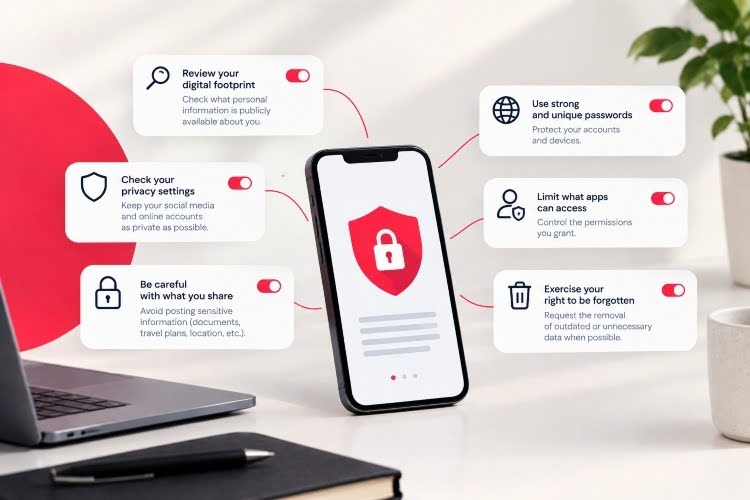
- Social media privacy settings. Adjust privacy settings on all social media accounts to limit who can see and access your personal information, and review and update them regularly. Be aware of your actual reach and the nature of your account (professional versus personal) and adjust the information you share and your privacy settings accordingly.
- Secure passwords and multi-factor authentication. Use strong, unique passwords for each online account, even if it is sometimes inconvenient. Also, enable multi-factor authentication whenever possible. This adds an extra layer of security by requiring a second form of verification, in addition to the password.
- Review of application permissions. Before installing an app, carefully review the permissions it requests and ensure they are necessary for it to function. With this information, limit app access to your personal information as much as possible.
- Monitoring of suspicious activities. Set up alerts for all activity, whether routine or unusual, on financial accounts and other important services. For individuals of social or economic importance with large amounts of highly sensitive data online, use online personal information and digital asset monitoring solutions to detect potential privacy threats that could lead to misuse.
- Be alert to suspicious emails, messages, and links. Never open emails or messages from unknown senders or click on links if you are not 100% certain of their legitimacy. Cybercriminals use phishing techniques to trick people and steal their personal information.
- Right to be forgotten. If at any point you believe that a company should no longer hold your personal data, you can and should request that it be deleted. Many laws, such as the GDPR in Europe, grant individuals this right.
Qondar: Enthec's platform that helps you protect your privacy
Qondar Personal Threat Watchbots is an innovative solution developed by Enthec to meet the growing need to protect individual privacy online. Qondar continuously and automatically monitors people's sensitive information and digital assets to protect personal privacy and prevent criminal or harmful use.
With this solution, the protected person receives real-time alerts about leaks and public exposures of their sensitive data, so they can remediate them and prevent criminal use.
Contact us to learn more about how Qondar can help you protect your privacy or that of relevant people in your organization.
Frequently asked questions about personal privacy
What is personal privacy?
It is a person's right to control what information about their life is shared, with whom, and under what conditions, both online and offline.
Is personal privacy the same as data protection?
Not exactly. Data protection is the legal framework (in Europe, the GDPR) that regulates how personal data is collected and processed. Personal privacy is the broader right that this legal framework protects.
What is the difference between personal privacy and digital privacy?
Personal privacy is the general concept; digital privacy is its version applied to the online environment, that is, social networks, apps, and algorithms that process your data.
How can I protect my personal privacy online?
Adjust privacy settings on social networks, use unique passwords with multi-factor authentication, review app permissions, and, if your public exposure is high, rely on a continuous monitoring tool like Qondar.
What is the right to be forgotten?
It is the right, enshrined in the GDPR, to request that an organization delete your personal data when it is no longer necessary for the purpose for which it was collected or when you withdraw your consent.


Deepfakes: what they are and how to detect them
Deepfakes are among the most disruptive phenomena artificial intelligence has generated in recent years. Understanding what a deepfake is, how it works, and how to detect it is no longer a technical matter reserved for experts; it's a digital survival skill for anyone or any company operating in connected environments.
In this guide, updated to 2026, you will find the complete definition of deepfake meaning, the types that exist, real deepfake examples, and the most effective tools to detect them before they cause harm.
What are deepfakes?
The term "deepfake" comes from combining two words: "deep learning" and "fake." It refers to media content manipulated using artificial intelligence algorithms, specifically deep neural networks, to create a highly realistic version of something that didn't happen.
In other words, deepfakes let you change faces, voices, or even movements in videos and audio, making it seem like someone said or did something that never happened. For example, you might see a celebrity singing a song they never performed or a politician giving a fake speech.

How do deepfakes work?
Deepfake AI is generated using advanced deep learning technologies. This involves training the AI with large amounts of data, such as images, videos, and audio of a person so that the machine learns to replicate their gestures, tone of voice, and facial expressions.
This process uses techniques such as GANs (Generative Adversarial Networks), which pit two neural networks against each other: one generates fake content, and the other evaluates its authenticity, improving the result with each iteration.
Thanks to tools available online, creating fake images has become easier. In the past, creating a deepfake required advanced programming skills and expensive equipment, but today, anyone with access to certain applications can generate a manipulated video.
How does deepfake AI work?
Deepfake AI is based on two main technologies that work in parallel:
GANs: Generative Adversarial Networks
The most widespread mechanism for creating deepfakes is the generative adversarial network (GAN). These work by pitting two neural networks against each other; one generates the fake content, and the other evaluates it until the result passes detection. Each iteration improves the quality of the deception.
Diffusion Models: the new generation
Since 2023, diffusion models (such as those powering Stable Diffusion or Midjourney) have partially replaced GANs in generating still images. They are more stable during training and produce higher-resolution results. In 2025-2026, multimodal models like Sora (OpenAI) or VideoPoet (Google) brought this technology to full-video synthesis.
How much data does a deepfake need to function?
In 2020, creating a convincing deepfake required between 50,000 and 100,000 images of the target person. By 2026, the latest models can generate a believable animated video from a single high-resolution photograph. This has democratized the process and exponentially increased the risk.
Why are deepfakes dangerous?
Now that you know what deepfakes are and how they work, we must emphasize that although this technology has positive applications, such as in entertainment, education, or marketing, its dark side is undeniable. Deepfakes have been used to spread fake news, impersonate identities, and even extort people.
Impact on society
- Spreading disinformation. Deepfakes have become perfect tools for disinformation campaigns. Manipulating a video to make someone believe something false can have serious consequences, especially during elections or social crises.
- Reputational damage. A fake image or video can ruin the reputation of a public figure or anyone, affecting their personal and professional life.
- Cyberbullying and fraud. Deepfakes have been used to create non-consensual content or to trick people into fraudulent activities.
Critical threats from deepfakes
The risk of deepfakes is not only technological; it is also economic, reputational, and social. These are the most critical threats identified in 2026:
Financial fraud and Business Email Compromise (BEC)
Audio and video deepfakes have become the most sophisticated attack vector in next-generation BEC fraud. An attacker can clone the CEO's voice or simulate a corporate video call to authorize fraudulent transfers. The FBI and Europol report that this type of fraud grew by 200% between 2023 and 2025, though exact figures vary by source.
Disinformation and reputational damage
A deepfake can destroy a person's or company's reputation in minutes. Content can go viral before it can be debunked. For companies, deepfake-driven reputational damage can be equivalent to months of public relations work.
Identity theft in authentication
Facial verification systems used in banking, insurance, or access to corporate platforms are vulnerable to high-quality deepfakes.
Impact on people's safety
On an individual level, deepfakes are used for cyberbullying, sex extortion, and identity theft. Platforms such as Qondar allow citizens to monitor whether their image or digital identity is being used without consent.

The 6 steps to detect a deepfake
Although they are becoming more and more realistic, deepfakes are not infallible. A few tricks can help you spot these fake images and protect yourself from deception.
- Notice the details of the face: Deepfakes often fail in subtle aspects, such as eye blinking, lip-syncing, or natural eyebrow movement. If a video seems strange, pay attention to these details.
- Analyze the audio: In manipulated audio, the intonation and rhythm of speech can sound mechanical or unnatural. Listen carefully if something doesn't fit.
- Look for lighting inconsistencies: Errors in shadows or reflections are common in deepfakes. It is likely false if the face's lighting does not match the environment.
- Use specialized tools: Currently, platforms are designed to analyze whether a video or image has been manipulated. Cybersecurity tools such as Deepware Scanner or InVID can help verify content authenticity.
- Trust official sources: Verify the information with reliable sources before believing dubious content. In many cases, deepfakes are designed to manipulate you emotionally and provoke immediate reactions.
- Use specialized detection tools. AI-based deepfake detectors analyze the digital fingerprints left by generative models. These tools fall under what cybersecurity companies call next-generation cybersecurity tools designed to detect synthetic content.
What to do if you find a deepfake?
If you suspect you have encountered a deepfake or that you are a victim of one, take the following steps:
- Don't share it: Spreading false content, even with the intention of denouncing it, amplifies its reach.
- Document the evidence: Download the content, save the URL, and note the date and context before it is deleted.
- Report on the platform: All major social media platforms have reporting mechanisms for manipulated, synthetic content. Use them.
- Notify the affected person: If the deepfake impersonates a known person, inform that person directly so they can take legal action.
- Contact INCIBE or your national Cybersecurity Agency: Spain's National Cybersecurity Institute and all the National Cybersecurity Agencies offer assistance to citizens and companies affected by digital security incidents, including deepfakes.
In the business context, deepfakes are an attack vector that must be considered in email security and identity-verification strategies.
Deepfake AI and regulation in 2026: what changes
The European Union's AI Act, in force since August 2026, establishes specific obligations for providers of generative AI systems. Among them is the obligation to label synthetic content with detectable digital watermarks. This measure, although relevant, does not solve the problem of deepfakes created with tools outside of European regulatory control.
In Spain, the GDPR and the Organic Law on Data Protection already allow individuals to file complaints with the Spanish Data Protection Agency (AEPD) regarding the non-consensual use of their image through deepfakes. However, attributing deepfakes to a specific author remains the main legal challenge in 2026.
The convergence of deepfakes with other threats such as SIM swapping, ransomware, and AI in cybersecurity is creating increasingly complex attack scenarios that require coordinated responses.
How can we help you at Enthec?
At Enthec, we know the challenges deepfakes pose to individuals. We provide cyber surveillance solutions that help people detect and prevent digital manipulation.
The impact of deepfakes is real, but with the right solutions, you can stay one step ahead. Contact us and protect what matters most: your credibility and security.
In a world where making someone believe something false is true has become so simple, prevention and knowledge are your best allies. Don't let deepfakes fool you: identify, protect, and take action
Trust Enthec to keep you safe in the digital environment.
Frequently asked questions about deepfakes
What exactly do deepfakes mean?
The term "deepfake" combines "deep learning" and "fake." It refers to any multimedia content generated or manipulated using artificial intelligence to impersonate a real person's appearance or voice without their consent.
Can a deepfake be made of anyone?
Technically, yes. By 2026, a single high-quality photograph could create a compelling animated video. That's why it's important to limit the public exposure of high-resolution images and implement digital identity monitoring protocols.
Are deepfakes illegal in Spain?
Using deepfakes without consent can be punishable under the GDPR, the Spanish Organic Law on Data Protection, and, in cases of harassment or extortion, the Spanish Penal Code. The European AI Act, in force since 2026, adds further obligations for creators of synthetic content in generative AI.
What is the difference between a deepfake and a shallowfake?
A deepfake uses artificial intelligence and neural networks to generate highly complex synthetic content. A shallowfake, on the other hand, is a simpler manipulation, such as slowing down a video, cutting out context, or editing subtitles, which doesn't require AI but can be just as deceptive.
How can I tell if a video of a video call is a deepfake?
In a real-time video call, watch for video quality issues (live deepfakes often have higher latency or inconsistent resolution), head movements at extreme angles (which current models distort), and unnatural facial expressions. In critical corporate environments, always establish a pre-agreed verification word with your contact.
Can deepfakes affect companies as well as individuals?
Yes, and with serious economic consequences. Deepfakes of executives, employees, or brand representatives are a growing vector of corporate fraud. Corporate cyber surveillance is the first line of defense for detecting these types of threats before they materialize.
Vishing: What It Is, How It Works, and How to Protect Yourself from Fraudulent Calls
The phone rings; you see a number that looks like your bank's, and you pick up without thinking twice. That's exactly what vishing is: a phone scam that uses social engineering and identity theft to steal your login credentials, verification codes, or money.
The term is a portmanteau of “voice” and “phishing,” and in recent years it has become one of the fastest-growing types of fraud in Spain.
What exactly is vishing?
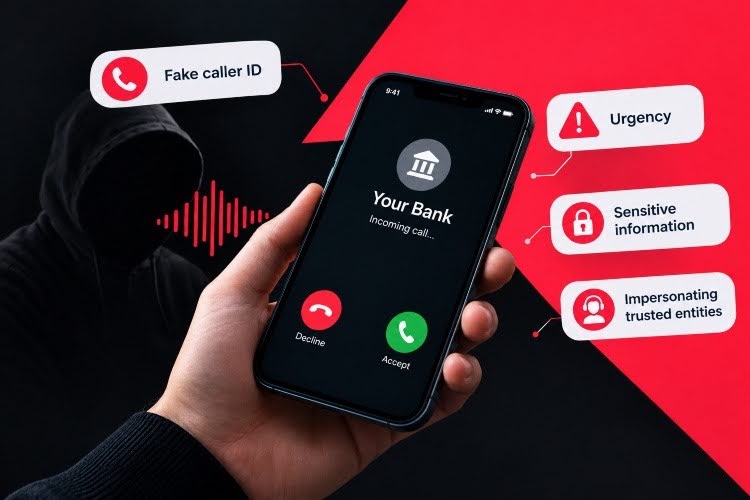
Vishing is a phone scam in which the attacker impersonates a trusted entity (a bank, the tax authority, a telecommunications provider, or a company’s technical support) to trick the victim into revealing sensitive information or authorizing a transfer. No malware is involved, and there is no link to click; the entire attack happens during the conversation.
According to data from INCIBE, the public cybersecurity agency handled more than 120,000 cybersecurity incidents in 2025—a 26% increase from the previous year—and the industry itself reports that vishing was one of the fastest-growing types of cyberattacks during that period.
The Ministry of the Interior recorded 489,248 cybercrimes in 2025, of which 430,493 were computer scams. Far from being an outdated channel for fraud, the telephone has become one of scammers' preferred methods.
How Does Vishing Work? The Anatomy of a Fraudulent Call
A vishing attack usually follows a fairly recognizable script once you're familiar with it, even if it seems convincing at the time:
- Caller ID spoofing. The number you see on the screen looks real—it even matches your bank’s number—because the attacker has forged it.
- A sense of urgency. They alert you to a suspicious charge, an account freeze, or a held package. The goal is to make you act out of fear rather than calmly.
- Request for information or codes. They ask you to “confirm” your identity by providing an SMS code, your PIN, or saying “yes” out loud—information that can later be used to access your accounts, just like an infostealer that compromised your device.
- Quick hang-up. Before you can verify anything through another channel, the call ends and the damage is already done.
What has changed in recent years is the technical sophistication. Voice cloning using artificial intelligence now makes it possible to imitate the voice of a family member or an executive with just a few seconds of audio—something that sounded like science fiction a few years ago but is now a real threat to businesses and individuals alike.
You might be interested in:> SIM Swapping: What It Is, How It Works, and How to Avoid This Scam in 2026
Examples of vishing currently circulating
Here are some of the most common examples of vishing reported in Spain:
| Call Type | What they say | What they're looking for |
| Fake Bank Security Department | “We’ve detected suspicious activity in your account” | SMS code or online banking password |
| Fake technical support | “Your computer has a virus; we need remote access” | Install remote control software |
| Fake Tax Agency | “You have a pending tax refund—please confirm your information” | Bank and personal information |
| Voice-Based CEO Fraud | “I’m the CEO; I need an urgent wire transfer” | Payment authorization from an employee |
| Fake telephone operator | “We’re going to upgrade your plan—please confirm the code you receive” | Fraudulent number porting |
This last scenario is particularly dangerous because, if the scammer manages to port your number, they can intercept the verification codes from your banking apps.
How to Spot a Vishing Attack Before It’s Too Late
There are signs that are almost always present, although sometimes it's hard to see them in the heat of the moment:
- They contact you unexpectedly and in a hurry, leaving you no time to think.
- They ask for information that the real organization would never ask for over the phone, such as your full PIN or an SMS code.
- They insist that you don’t hang up and call that number yourself to “verify” that it’s legitimate: that’s exactly the opposite of what you should do.
- The caller ID matches your bank’s actual number—but that’s no longer a guarantee of anything, since caller ID spoofing is commonplace.
An important note: the classic advice to “hang up and call the number you have saved” is still valid, but only if you manually dial the number from your own phone—never call back or press any buttons the scammer suggests.
How to Avoid Vishing
Preventing vishing doesn't depend on having more technology, but on changing a few habits:
- Never give out verification codes over the phone. No legitimate organization asks for them that way.
- Hang up and verify through another channel. Contact your bank through the official app or the phone number listed on your documents—not the one that called you.
- Be wary of any sense of urgency. Almost any real problem can wait ten minutes while you verify the information.
- Install a call blocker that uses a database of numbers reported as fraudulent.
- If you run a business, train your team. Voice-based CEO fraud has grown because many employees don't know it exists.
If you’ve already provided any sensitive information, act quickly: block your cards or access through your bank’s app, change your passwords, and file a report with the police or the Civil Guard. The sooner you act, the less time the scammer has to use that information.
Vishing in the Business World: Continuous Monitoring vs. Exposure
For a company, even one employee falling victim to vishing can open the door to a credential leak, CEO fraud, or unauthorized access to internal systems. One-time training is no longer enough; you must know at all times what data, credentials, or references about the organization are circulating externally, because many vishing campaigns are built using information from previous data breaches or exposed corporate profiles.
This is precisely what Continuous Threat Exposure Management (CTEM) is—a cyber-surveillance approach that continuously monitors what information about your company, your employees, or your suppliers is accessible to a potential attacker before they can use it.
Kartos, Enthec's cybersecurity monitoring solution, applies this CTEM model to businesses, detecting leaked credentials, data exposure, and attack surfaces that are later exploited in targeted vishing campaigns.
Frequently Asked Questions About Vishing
Is vishing the same as phishing?
No. Phishing occurs via email or a link, while vishing occurs via a phone call. Both aim to steal data or money, but they use different channels and different manipulation techniques.
Can the bank refund my money if I fall victim to a vishing scam?
It depends on the specific case. If someone accessed your account without your consent, PSD2 regulations require the bank to refund the amount. If you authorized the transaction under false pretenses, the process is more complicated, although Spanish courts are increasingly ruling in favor of victims.
How do I know if a call from my bank is real?
Hang up and call the official number listed on your card or in the app yourself. Never use the number that called you or the one the caller suggests.
Are small businesses also targets of vishing?
Yes, in fact, they are a common target precisely because they tend to have fewer verification protocols than large corporations, and a single transfer authorized by mistake can result in a significant loss.
Digital Supply Chain Risk: Why Your Supplier's Security Breach Could Be Your Problem
Your company may have the best firewall on the market and still suffer a data breach without anyone ever having accessed your network. All it takes is for one of your vendors to have exposed credentials or a misconfigured server.
This is, in essence, the risk of the digital supply chain—that is, the exposure you inherit from every application, cloud service, or integration you connect to your business, even if you don’t manage it directly.
What exactly is digital supply chain risk?
When we talk about digital supply chain risk, we're referring to the vulnerabilities that enter your organization through third parties such as the invoicing software your finance department uses, the CRM where you upload customer data, or the logistics provider that has access to your ERP. Each of these points is a gateway that you don’t control, but for which you are held accountable.
This isn't a new problem, but in the past, a company typically had five or six critical suppliers. Today, with software as a service, APIs, and outsourcing, the list easily exceeds a hundred, and a large portion of it isn't even tracked.
Why a Supplier's Shortfall Becomes Your Problem
Here’s the nuance that many companies overlook: legally—and in the eyes of your customers—it almost never matters who made the mistake, but rather who is ultimately responsible for the data. And we’re not just talking about a financial penalty, but also the reputational damage that will follow the company.
According to an analysis by Cipher (Supply Chain Attacks: 2025 Analysis and 2026 Trends), by 2025, 22.5% of all reported security breaches involved a supplier or third party—twice as many as the previous year. And yet, most organizations continue to assess their cybersecurity solely from the inside.
The Most Common Blind Spots in Your Supply Chain
Most third-party security breaches result from oversights that build up over time and that no one stops to review:
- Subdomains and Forgotten Assets: test environments or old websites that are still active and unpatched.
- Leaked credentials: employee or vendor passwords circulating on the deep web following a third-party breach.
- Unreviewed third-party access: integrations and permissions granted once and never audited.
- Shadow IT: applications that a team procures without going through the IT department.
- Mentions on underground forums: Information about your company circulating on the dark web without your knowledge.
Any of these points can become the source of an incident if no one monitors them constantly.
From the Annual Audit to the CTEM Approach
For years, the standard response to this risk was one-time on an ad hoc basis or vendor audit once a year. The problem is that months can pass between reviews, during which the attack surface can change completely.
| Focus | Frequency | What it detects | Main limitation |
| Annual Audit
|
On time, once a year | Snapshot of the security status | Outdated within weeks |
| Periodic Penetration Testing
|
Every 6–12 months | Known technical vulnerabilities | Does not cover third parties or new assets |
| CTEM (Continuous Threat Exposure Management)
|
Continuous | Actual exposure, compromised credentials, forgotten assets, vendor risk | Requires a specialized tool |
CTEM (Continuous Threat Exposure Management) is based on a different concept: cybersecurity isn’t a test you pass once a year; it’s a process that must be monitored every day. Instead of waiting for the next audit, the goal is to have constant visibility into what is at risk, where, and how urgently action is needed.
This is where Enthec comes in, with its cyber-surveillance solutions designed specifically for this approach. Kartos, its enterprise platform, continuously monitors an organization’s exposed digital footprint and that of its critical suppliers. It detects leaked credentials, forgotten domains, and mentions on underground forums before they turn into an incident.
For those who manage their own exhibitions as professionals or freelancers, Enthec also offers Qondar, designed to monitor digital identity on an individual level.
What Your Company Can Do Starting Today
There's no need for a radical change overnight, but it's a good idea to start moving in this direction:
- Take a real inventory of your critical suppliers and what data or access each one has.
- Ask those vendors what security controls they implement and whether they are willing to share that information.
- Replace one-time reviews with continuous monitoring of your company’s and your value chain’s exposure.
- Prioritize based on impact, because not all suppliers require the same level of scrutiny.
Frequently Asked Questions
What is the difference between third-party risk and digital supply chain risk?
Third-party risk focuses on each individual supplier—their controls, certifications, track record, and so on. Digital supply chain risk is broader; it encompasses the entire network of technological dependencies through which an incident can spread.
How is the risk of a digital supplier measured?
It combines public information—such as exposed domains, leaked credentials, or reputation—with security questionnaires and, when possible, continuous monitoring of its exposure surface using cyber-surveillance tools.
Does CTEM replace penetration testing?
No, it complements it. Penetration testing remains useful for testing specific controls at a given time. The CTEM provides continuous monitoring between those one-off tests.
What size of company needs to monitor its digital supply chain?
Any company that relies on external suppliers to operate—which, these days, is practically any company with an online presence, regardless of its size.
If you want to know how much exposure your company and your critical suppliers have today, you can request a Kartos demo and see firsthand what it finds in your digital landscape.

How can your credit card data be stolen?
Spain is the third-most-affected European country for stolen credit cards sold on the dark web. According to a 2025 NordVPN study, Spanish users' banking data sells for an average of $11.68 per card, usually in bundles, suggesting the volume of compromised cards circulating in illegal markets. Meanwhile, in February 2026, Spanish banks and the OCU (Spanish Consumers' Organization) issued alerts after detecting a wave of fraudulent charges of just a few cents, designed to test whether a card is working before the final theft.
Knowing how your card details are stolen and what they do with them afterward is the first step to avoid becoming a victim.
Theft of credit card data in non-face-to-face transactions
In recent years, EMV systems have been implemented to prevent the physical cloning of credit cards. EMV is a payment method based on a technical standard for smart payment cards, payment terminals, and ATMs that can accept them. EMV stands for "Europay, Mastercard, and Visa," the three companies that created the standard.
That's why credit card vulnerabilities are more common during card-not-present (CNP) transactions.
How can they steal your credit card information? Most common forms
Cybercriminals use a variety of techniques to obtain your card details in both physical and digital environments. These are the most widespread methods currently used:
Phishing, smishing, and vishing
Phishing is the most common method. The attacker impersonates your bank, a courier company, or a payment platform (Amazon, PayPal, BBVA, CaixaBank, etc.) and sends you an email or SMS with a link to a fake website where you unknowingly enter your card details.
- Smishing: The same technique is used via SMS. You often see messages like, "Your package is being held, please enter your details to release it."
- Vishing: Phone call. The "fake bank technician" scam involves someone who detects a suspicious purchase and asks you to confirm details to cancel it.
In all cases, the objective is the same: for you to voluntarily enter the card number, expiry date, and CVV.
Web skimming (formjacking)
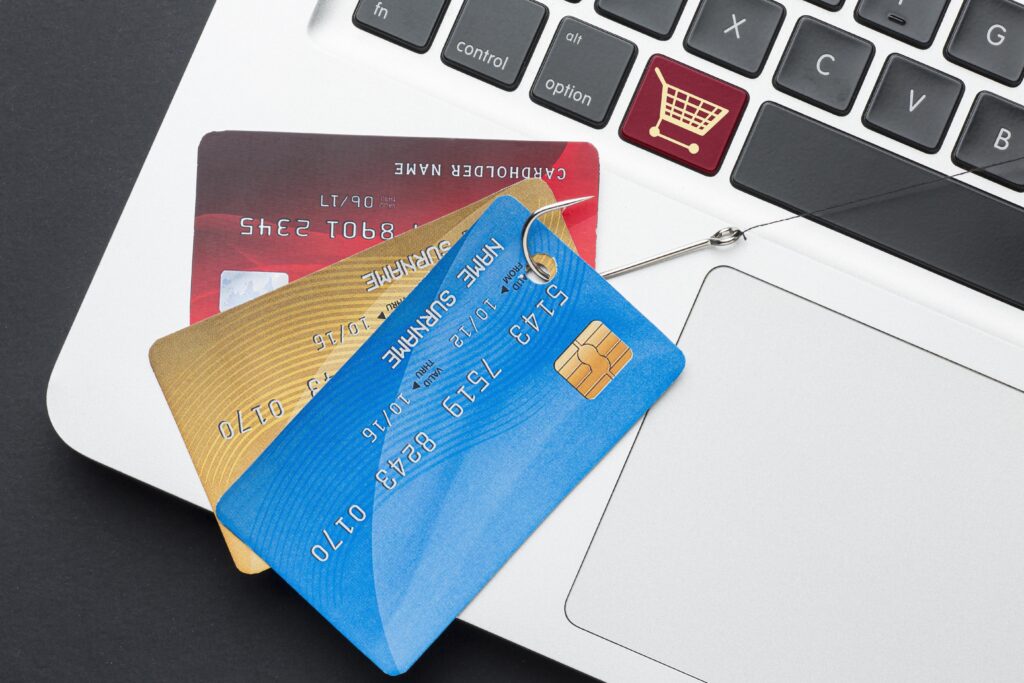
Web skimming, also known as formjacking, involves injecting malicious JavaScript code into the payment page of a legitimate online store. The code is completely invisible to both the user and the merchant. It captures card details as soon as they are entered and sends them to the attacker's server.
Skimming and shimming on ATMs and data phones
Although EMV (chip) systems drastically reduced classic skimming, criminals have evolved:
- Skimming: Installation of a physical device over the card reader of an ATM or point-of-sale terminal that copies the magnetic stripe. Modern models incorporate Bluetooth transmission to extract data remotely.
- Shimming: The most recent and difficult-to-detect variant involves criminals inserting an ultra-thin electronic strip (shim) into the card reader slot. This shim intercepts communication between the card's EMV chip and the terminal, allowing them to read enough data to create fraudulent magnetic stripe cards.
Corporate data breaches
When criminals attack a company that stores payment data, they can obtain thousands or millions of card records in one fell swoop. These breaches are especially profitable for attackers and are the primary source of leaked credit card information sold on the dark web.
Data stolen in corporate security breaches can take months to appear on illegal markets. This prevents users from linking the leak to a specific incident.
Public WiFi networks and man-in-the-middle attacks
When you connect to an unencrypted public Wi-Fi network (airport, coffee shop, hotel) and make a purchase, an attacker on the same network can intercept the communication and capture your card details. This technique, known as a man-in-the-middle attack, is less common today thanks to HTTPS, but it remains an active vector in poorly configured networks.
Malware and spyware on devices
Malicious apps or infected downloads can install a keylogger or spyware that records everything you type, including your card details when making online purchases.
| Technique | Environment | How it works | Warning sign |
| Phishing / smishing | Online / Mobile | Email or SMS with a link to a fake bank website | Suspicious URL, urgency in the message |
| Vishing | Telephone | A call from "your bank" asking for details | No bank asks for the CVV over the phone. |
| Web skimming | Online stores | Malicious code in the payment form | Difficult to detect as a user |
| Physical skimming | ATMs and POS terminals | Device superimposed on the reader | Reader with loose or strange parts |
| Shimming | ATMs and POS terminals | Foil in the EMV chip slot | Almost impossible to detect with the naked eye |
| Data leak | Companies | Database breach in a business | Unknown charges weeks later |
| Public WiFi | Open Networks | Interception of the unencrypted connection | Password-free Wi-Fi in public places |
| Malware / keylogger | Own device | Malicious app or download records keystrokes | Strange device behavior |
How are credit cards cloned?
Card cloning is the process by which criminals create a physical or virtual copy of your card using stolen data to make fraudulent purchases.
There are two main types:
- Physical cloning: Using data obtained from the magnetic stripe via skimming, criminals encode a blank card with that information. This allows it to be used in stores that still accept magnetic stripe cards (increasingly less common in Europe, but still common in some Latin American countries or for in-person purchases with outdated terminals).
- Virtual cloning (carding): Using the card's full details (number, expiration date, and CVV), criminals can make online purchases directly, without needing to manufacture any physical object. This has been the dominant method in Spain since the widespread adoption of the EMV chip.
The entire carding process operates like an industrial chain: some criminals steal the data, others validate it by making micropayments of cents to verify that the card is active, and a third group exploits it until the available credit is exhausted.
What can they do with your card details?
Once your card details are in the hands of attackers, the most common uses are:
| Fraudulent use | Description |
| Direct online purchases | They place orders in online stores on behalf of third parties or with an anonymous shipping address |
| Selling on the dark web | They sell the data in packages to other criminals at an average price of €10 per card in Spain |
| Carding (test micropayments) | They make minimal charges (€0.50–€1) to verify that the card works before operating. |
| Creation of cloned physical cards | Using magnetic stripe data, they manufacture cards for use in chip-free POS terminals |
| Identity fraud | They combine your card details with other personal information to impersonate you. |
| Fraudulent transfers or tricks | In some cases, they can access online banking if they also have the login credentials. |
My credit card was hacked: signs to detect it and what to do
If you suspect your credit card has been hacked, or that your data is part of a credit card leak, the signs often appear sooner than you think, although almost no one associates them with fraud until the damage is already visible.
These are the most frequent signs that indicate your card details may have been compromised:
- Unknown charges on your statement, especially micropayments of cents (a classic sign of carding).
- Notifications from your bank for purchases you did not make, even if you had the card at all times.
- Failed attempts to access your online banking from unknown devices or locations.
- You receive purchase confirmations for orders you didn't place. Sometimes on platforms you don't even know exist.
- Your card is declined for a routine purchase for no apparent reason (this may indicate the bank blocked it due to suspicious activity detected before you).
- Your bank details appear in a data breach alert, such as those issued by Qondar when it detects your credentials on the dark web.
Practical rule: Review your card transactions at least once a week. The sooner you identify a fraudulent charge, the easier it is to recover your money and the less damage it can do.
What to do if your card details have been stolen?
If you detect unauthorized charges or suspect that your data has been compromised, act in this order:
- Call your bank immediately to block or cancel the card. Most have a 24-hour helpline. Do it even if you're not sure; it's free and reversible.
- Document fraudulent charges with screenshots of the statement before the bank removes them from the visible history.
- File a complaint with the National Police or the Civil Guard. This is necessary for the bank to process the refund and for the police investigation to move forward.
- Request a chargeback from your bank. In cases of card fraud, European regulations (PSD2) require banks to return the amount immediately in most cases, except in cases of serious cardholder negligence.
- Check if your data is circulating on other platforms using monitoring tools like Qondar. Credit card data breaches often expose other personal data as well.
- Change the passwords on the platforms where you saved that card. (Amazon, PayPal, plataformas de streaming...).
How to protect your credit card data: a practical guide 2026
Online shopping
- Only buy from websites with HTTPS and recognized trust seals.
- Use single-use virtual cards for purchases at stores you don't know.
- Activate real-time notifications from your bank for every charge.
- Avoid saving your card details on platforms if you don't use them regularly.
- Never make purchases while connected to a public WiFi network without a VPN.
At ATMs and card payment terminals
- Visually inspect the reader before inserting the card. If it has loose parts, play, or anything stuck to it, do not use it.
- Prefer contactless (NFC) payment to push notifications whenever possible: it eliminates the risk of shimming.
- Cover the keypad with your hand when entering the PIN, even if you don't see any cameras.
- Preferably use ATMs located in bank offices or large establishments.
On your device and email
- Do not click on links in SMS messages or emails that ask you to confirm bank details, even if the sender appears to be your bank. Always access your account through the official app or by typing the URL directly.
- Keep your operating system and applications updated to close malware vulnerabilities.
- Activate two-factor authentication (2FA) on your online banking.
Continuous monitoring
Reactive protection has its limits; you act only after you know something has happened. Continuous monitoring of your data on the dark web, like that offered by Qondar, allows you to detect a breach before it can be exploited.
Learn more about personal privacy and how to protect it.
Qondar: Continuous monitoring of your banking data on the web and the dark web
Most credit card fraud goes undetected until the damage is already done. The problem is that weeks or months can pass between when your data is leaked and when a criminal uses it.
Qondar, Enthec's personal cyber-surveillance platform, solves exactly this problem. It automatically and continuously monitors whether your card details, such as the number, expiration date, and combinations with your email or phone number, appear in leaked databases, carding forums, dark web marketplaces, or any other source of exposure.
When it detects that your data is being transmitted, it alerts you in real time. So you can cancel the card, notify the bank, and block any use before the impact becomes greater.
You don't need technical knowledge. Qondar works in the background, like a permanent alarm system for your identity and digital assets.
Frequently Asked Questions
How can they steal my card details without taking the card from me?
Through digital techniques such as phishing (fake websites that impersonate your bank), web skimming (malicious code in online stores), or malware on your device. They can also use physical devices installed on ATMs (skimming and shimming) that capture data when you insert your card.
What is a leaked credit card?
A leaked credit card is one whose data criminals have illegally obtained and sold or distributed on dark web marketplaces or carding forums. In 2025, Spain was the third European country with the most leaked credit cards circulating on these markets.
How are credit cards cloned?
Through skimming (devices on ATMs that read the magnetic stripe) or shimming (sheets that intercept the EMV chip), criminals obtain data to manufacture counterfeit physical cards. In online environments, virtual cloning uses the card number, expiration date, and CVV to make purchases without needing a physical card.
How can I tell if my debit or credit card has been hacked?
The clearest signs are unfamiliar charges on your statement, purchase confirmations you didn't make, or your card being declined for no apparent reason. You may also receive alerts from your bank or tools like Qondar if your data appears in a data breach.
What can they do with my card details?
They primarily use them to make fraudulent online purchases, sell them on the dark web to other criminals, or create cloned physical cards. In some cases, they also combine them with other personal data to impersonate you with your bank.
Will the bank refund my money if my card has been hacked?
In most cases, yes, as long as you report it promptly and you were not grossly negligent. European regulations such as PSD2 require banks to refund the amount immediately in cases of card fraud.
Is it the same if my physical card is stolen as if my data is stolen?
No. If your physical card is stolen, the bank blocks it and issues a new one. If someone steals your data (number, expiration date, CVV) without you losing the card, you may keep using it without knowing it's compromised, while criminals use it online. That's why early detection is crucial.
How can I prevent my card details from being leaked?
Use single-use virtual cards for online purchases, activate real-time notifications, avoid entering data on websites without HTTPS, physically inspect ATMs before using them, and use continuous monitoring tools like Qondar to see whether your data has appeared in any data breaches.
What is doxing: Definition, risks, and how to protect yourself
The Internet is a space where we share information daily. Social networks, forms, online purchases… Each action leaves a slight digital trace. Most of the time, we are unaware of how much we reveal about ourselves. This is where an increasingly well-known and feared concept comes into play: doxing.
What is doxing, and why should you care?
Doxing (short for dropping dox or "dropping documents") is the practice of collecting and publishing a person's personal information without their consentwith the aim of exposing, intimidating, or harming them. This may include her full name, address, phone number, email address, place of work, private photos, family information, and even financial data.
What distinguishes doxing from a simple Google search is the intention: the doxer gathers scattered information from multiple sources such as social networks, leaked databases, public records, the dark web… to build a detailed profile of a person and use it against them.
These types of attacks, which initially emerged in very specific online communities, have spread in recent years and can have serious consequences: from harassment, threats, and identity theft… up to and including job loss or legal problems.
Doxing on the internet is not just a simple hacking game. It is a form of digital violence classified in Spain and many other countries with penalties that can reach up to four years in prison.
Qondar: Personal cyber-surveillance to know when you're being doxed before it's too late
Before continuing, it is worth stopping at our featured tool: Qondar, a solution for personal cyber surveillance.
Qondar has been developed for anyone who wants to maintain control over their information on the network without needing advanced technical knowledge. It works like a Continuous Threat Exposure Management (CTEM) platform. It lets you detect if your data is being shared without permission in forums, leaked databases, social networks, or even the dark web.
Even if you don't know what doxing on the internet is, you may still suffer an attack. If so, Qondar will tell you before it's too late.
Why does someone decide to dox another person?
There is no single attacker profile or motivation. Doxing, as this phenomenon is also known, can have many faces:
- Personal revenge: Ex-partners, ex-friends, or work conflicts can lead to malicious leaks.
- Extreme ideology or activism: Some users publish data about opponents to intimidate or silence them in political or social debates.
- Practical jokes or viral challenges: especially among teenagers or in toxic online communities.
- Extortion and blackmail: Once they have your data, some attackers try to obtain money or favors in exchange for not disclosing it.
- Coordinated harassment. Organized groups (sometimes called hate brigades) simultaneously attack the same person, especially journalists, activists, or public figures.
- Professional cybercrime. Personal information such as DOB, address, and phone number is sold on specialized forums to facilitate identity fraud.
Whatever the reason, the result is the same: your privacy and security are compromised.
What type of data is typically exposed when doxing?
Although the degree of exposure varies, the most common data that is published or sold in doxing cases are:
- Full name and physical address
- Phone number
- Profiles on social networks (including anonymous accounts linked to the person)
- Personal photos
- Information about the family environment
- Employment or academic data
- Purchases, searches, donations, or affiliations
A simple cross-referencing of leaked databases, like those circulating on the dark web, can be enough to build a complete profile in minutes. That's why prevention is more effective than reaction.
Bonus: Where is doxed data published? Primarily on platforms like Doxbin (accessible from the open web, with nearly 200,000 registrations), dark web forums, Telegram channels, and, in cases of coordinated harassment, directly on social networks like X or Reddit.
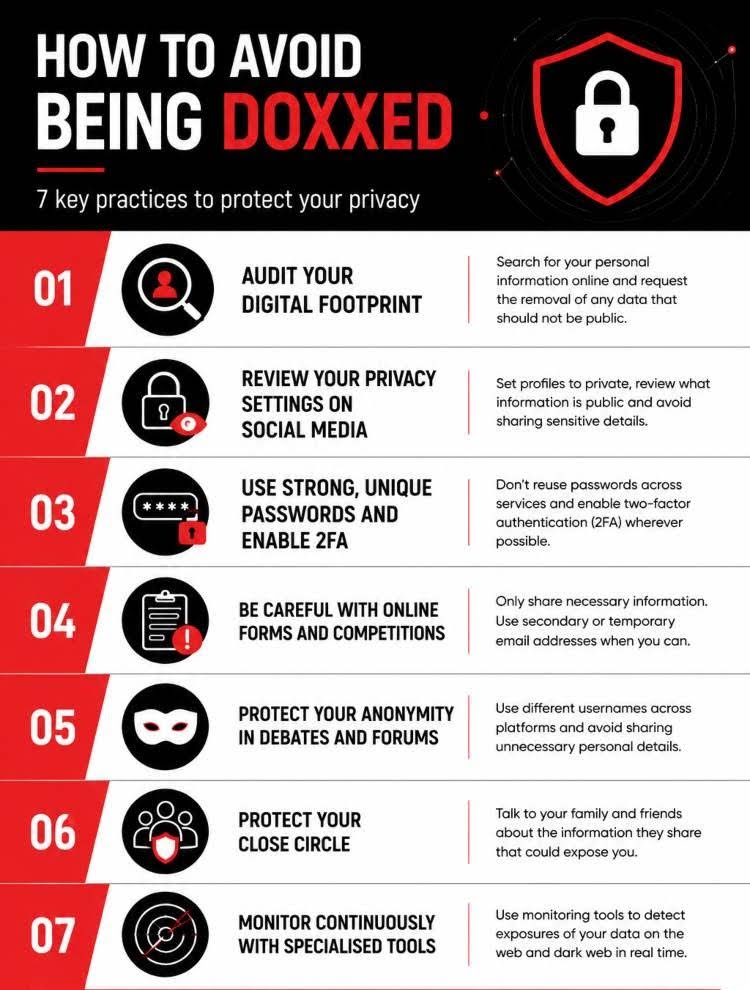
How to avoid being doxed: good practices to protect your privacy
To know how to protect yourself from doxing involves changing certain digital habits.. Here are some practical tips that you can start applying today, now that you understand what doxing is:
-
Audit your digital footprint regularly
Enter your first and last name into search engines and see what comes up. Also search for combinations with your email address, phone number, and most-used username. If you find data that shouldn't be public, request its removal by exercising your right to be forgotten through your national Data Protection Agency.
Tools like Qondar automate this process by monitoring any new occurrences in your data in real time and notifying you immediately.
-
Review the privacy settings of your social media accounts
- Activate private profiles on Instagram, TikTok, and Facebook.
- Check what information is public on LinkedIn (date of birth, phone number, location).
- Delete or limit your Facebook posting history.
- Do not post documents, plane tickets, or photos that show your address or car registration.
You might be interested in→ 5 social media security strategies.
-
Use strong, unique passwords and enable 2FA
- Do not reuse passwords across multiple services.
- Enable two-step authentication (2FA) whenever possible.
Learn how to manage passwords properly.
-
Beware of online forms and contests
- Do you really need to give your phone number to enter that raffle?
- Use secondary or temporary email addresses whenever possible.
-
Protect your anonymity in public debates and forums
Many doxing victims are targeted precisely because of their opinions expressed online. If you participate in polarized debates, avoid using the same username on multiple platforms and don't post unnecessary personal details.
-
Protect your immediate surroundings
Doxing often involves information about family members. Talk to people in your life about what information they post that could locate you (mentions of your workplace, photos taken at your home, geolocation of joint posts).
-
Continuously monitor with specialized tools
Manual protection has its limits. Continuous monitoring solutions like Qondar allow you to detect exposures in real time, including the appearance of your data on the dark web or in leaked databases, before the damage becomes irreversible.
What do you do if you have been doxed?
If you're already a victim of doxing, act quickly. Every hour counts.
- Document everything before requesting withdrawals. Take screenshots of all published content, including URLs.
- Contact the platforms where the information has been published. Use the content removal forms from Google, Meta, X, and any other involved platforms.
- Report it to the National Security Authorities, especially if there are threats, blackmail, or sexual content. Doxing can be classified as discovery and disclosure of secrets, harassment, or threats.
- Contact your national Data Protection Agency if your data protection rights have been violated. In 2025, the Spanish AEPD imposed a record 40 million euros in sanctions, reflecting its growing activity in defense of citizens.
- Inform those around you so that they are alert to possible attempts at social engineering using your information.
- Seek psychological support if the emotional impact is intense. Cyberbullying can cause anxiety, post-traumatic stress, and social isolation.
Is there any definitive protection against doxing?
There is no 100% foolproof barrier. But you can drastically minimize your exposure and be prepared to act before the damage becomes serious.
The key lies in early detection. On the internet, published data is indexed, copied, and distributed within minutes. What takes hours to publish can take years to disappear. That's why continuous and proactive monitoring of your digital identity is the most effective measure available today.
This is precisely what Qondar does: to continuously and automatically monitor whether your information appears where it shouldn't, and alert you in real time so you can take action. No technical knowledge required. No interruptions to your daily routine.
Now that you know what doxing is, it's clear that it's not a problem exclusive to celebrities or public figures. In a world where identity theft on social media is growing year after year, protecting your personal information is crucial.
Your privacy is part of your security. Start protecting it today.
Frequently Asked Questions
What does it mean to dox someone?
Doxing someone means collecting and publishing that person's personal information (name, address, phone number, workplace, etc.) without their consent, with the aim of exposing, intimidating, or harming them.
Is it a crime to dox someone?
Yes. Although most penal codes around the world do not use the term "doxing," the practice can be classified as disclosure of secrets, harassment, or threats, with penalties of up to four years in prison. It can also lead to sanctions for violations of the Data Protection Acts and the Data Protection Regulations.
How do I know if I'm being doxed?
The most common signs are receiving threatening messages from strangers, noticing that people you don't know know details of your private life, or finding posts with your personal information on forums or social networks.
Tools like Qondar allow you to detect it proactively, before the effects are visible.
How to avoid being doxed?
The most effective measures are to audit your digital footprint regularly, properly configure privacy settings on social networks, use unique passwords with 2FA, be cautious with the data you provide in forms, and use continuous monitoring solutions like Qondar.
What do I do if someone has published my personal data without my permission?
Document everything with screenshots, request the removal of the content from the platform and Google through the right to be forgotten, report it to the Security Authorities, and go to the Data Protection Agency if your data protection rights have been violated.
Infostealer, the malware that silently steals your credentials before anyone detects it
An infostealer is a type of malware designed to steal passwords, session cookies, and banking information from a device without the victim noticing. It doesn’t encrypt files, display a ransom note, or slow the computer down. It simply copies whatever it finds and sends it to an external server.
That’s why, by the time someone discovers they’ve been infected, it’s usually too late—their credentials have been circulating on dark web forums for weeks or months.
Infostealer: What It Is and Why It’s Hard to Notice It’s There
The question of what an infostealer is has a more unsettling answer than usual: it is software designed to go unnoticed. Unlike ransomware, which requires the victim to know they’ve been attacked in order to demand a ransom, the infostealer relies on the opposite. The longer it goes undetected, the more new passwords it can capture each time the user logs in to a different service.
It is usually installed through pirated software cracks, a fake browser extension, or a legitimate-looking email attachment. Once inside, it runs just once, steals whatever it can, and in many cases self-destructs.
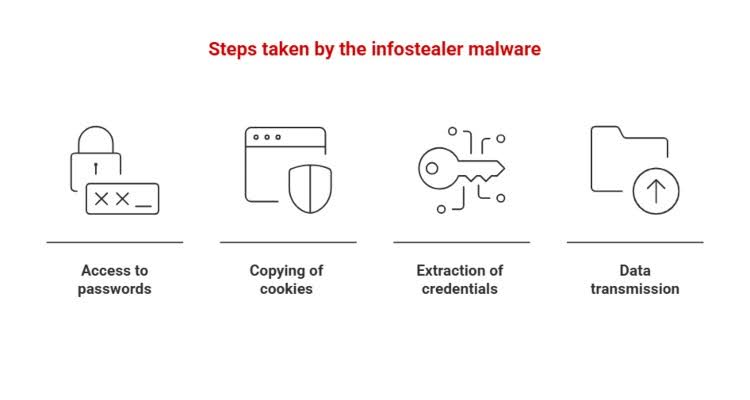
How InfoStealer Malware Works, Step by Step
The infostealer malware follows a fairly consistent pattern, although each family (Lumma, RedLine, Vidar, and Raccoon are the most active) has its own technical variants:
- It accesses the database where the browser stores passwords and decrypts them locally.
- It copies active session cookies, allowing it to impersonate the user even if two-step verification is enabled, because that cookie already proves that the MFA has been completed.
- It extracts credentials from email clients, corporate VPNs, and cryptocurrency wallets.
- It packages everything into a file called "stealer log" and uploads it to a Telegram channel or a dark web marketplace.
That last step is crucial. Stealer logs are collected, organized by domain, and resold to other cybercriminals for months on end. A stealer log collected today may still be useful to an attacker a year from now.
Statistics that explain why infostealers have become the biggest silent threat
The figures from the latest industry reports leave little room for doubt. According to Flashpoint, infostealers stole more than 1.8 billion credentials in 2025 from 5.8 million infected devices, an 800% increase compared to the previous four months.
|
FACT |
FIGURE |
SOURCE |
|
Credentials stolen in 2025 |
+1.8 billion |
Flashpoint |
|
Bank accounts compromised in 2025 |
+1 million |
Kaspersky |
|
Stolen cards still valid as of March 2026 |
74% |
Kaspersky |
These figures paint a consistent picture. When an infostealer enters the picture, there’s almost always a larger attack behind it—whether it’s ransomware, banking fraud, or unauthorized access to corporate systems. The infostealer is rarely the final attack. It’s the gateway.
Why Passwords Are No Longer the Barrier You Think They Are
Here, it’s worth challenging a piece of advice that’s often repeated without nuance: “Change your password every three months, and you’ll be protected.” With an active infostealer, that’s not enough. If the malware steals the session cookie during the attack, the attacker doesn’t need to know the password or bypass two-factor authentication. They log in directly using the already-established session, as if they were the user themselves.
This changes the defense strategy. It’s not enough to simply react when a suspicious login alert comes in. You need to know, in advance, whether your credentials are already circulating in a log stealer, before anyone uses them. That leap separates reactive cybersecurity from continuous monitoring.
How to Protect Yourself from an Infostealer Virus, Both at Work and at Home
Some measures significantly reduce the risk, although none is foolproof on its own:
- Avoid installing pirated software, cracks, or browser extensions from dubious sources—the most common entry point.
- Use a dedicated password manager instead of saving your credentials in your browser.
- Log out of sensitive services when you’re done, rather than leaving them open indefinitely.
- Check periodically to see if your email address or passwords have appeared in any known data breaches.
For a company, however, manually checking the dark web for leaked corporate credentials is not feasible at scale. This is where Continuous Threat Exposure Management comes into play—a framework that involves constantly monitoring an organization’s actual exposure surface, rather than conducting one-off audits once a year.
Enthec operates on this approach, offering two complementary cybersecurity solutions. Kartos, designed for businesses, continuously monitors whether corporate credentials, domains, or digital assets are exposed on dark web forums and marketplaces before an attacker can use them.
Qondar, aimed at individuals, does the same at an individual level, checking whether your personal information has appeared in any keylogger logs or data breaches so you can act before falling victim to fraud.
If you manage security for an organization, or simply want to know if your data is already circulating without your knowledge, it’s worth checking what information about you or your company is currently exposed. Contact us.
Frequently Asked Questions About the Infostealer
How do I know if I have an infostealer on my computer?
It's difficult to detect based on visible symptoms, because it doesn't slow down the system or display any warnings. The most reliable way is to check whether your credentials have appeared in any known data breach databases or to use a monitoring service that continuously monitors the dark web.
Does a standard antivirus program detect an infostealer virus?
It can detect known variants, but many families are updated every few weeks precisely to evade the signatures of traditional antivirus software. That is why the subscription model (“malware as a service”) used by the operators of these campaigns is so effective.
Is changing my password enough if my computer has been compromised by an infostealer?
Not always. If the malware also stole the active session cookie, the attacker can continue to gain access until that session is manually closed on all devices—not just until you change your password.
What is the difference between an infostealer and ransomware?
Ransomware alerts the victim because it needs to negotiate a ransom. An infostealer, on the other hand, aims to do the opposite: go unnoticed for as long as possible so it can keep collecting data without arousing suspicion.
Reactive vs. Proactive Cybersecurity: What's the Real Difference, and Why Does It Matter to Business?
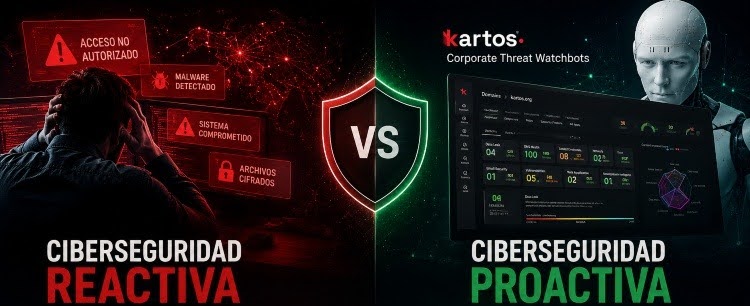
A company detects unauthorized access to its network on a Tuesday morning. The IT team spends the next 48 hours putting out fires, isolating servers, reviewing logs, and explaining to management what happened. That is reactive cybersecurity in its purest form: responding after the damage has already been done.
Proactive cybersecurity raises a different question. Instead of asking, “How do we fix this?”, ask, “How did we know this could happen, and why didn’t we act sooner?” The difference may seem semantic, but it completely changes the cost, impact, and reputation associated with an incident.
What Exactly Is Reactive Cybersecurity?
Reactive security is based on detection and response after the fact. An antivirus program that blocks malware after it has already been executed, a SOC that analyzes an alert after the attack, a recovery plan that is triggered once the ransomware has already encrypted files. It’s not useless—far from it—and without these layers, any incident would be much worse.
The problem is that this model assumes the attack will occur first and the defense will react afterward. And it is during that window of time—between when the attacker gains access and when the company becomes aware of it—that almost all of the actual damage occurs: data theft, lateral movement across the network, and extortion.
The IBM study (Cost of a Data Breach Report 2026) estimated the average time to identify and contain a breach at 247 days. That’s more than eight months during which an attacker can move freely within a company’s systems, while the company remains unaware that it has been compromised.
What Changes with a Proactive Approach
Proactive cybersecurity doesn't wait for an alert. It looks for the conditions that make an attack possible before anyone can exploit them—such as credentials leaked on forums, unpatched vulnerabilities, fraudulent domains impersonating the brand, and exposed digital assets that no one even remembers exist.
This requires something that many companies still lack: continuous visibility into their own exposure, not just a one-time snapshot once a year. A penetration testing The annual report describes the security status on the day the test was conducted. Three months later, that photo is no longer useful, because the infrastructure, vendors, and exposed credentials change every week.
This is where the concept of continuous threat exposure management. It is, quite simply, a shift in approach: it involves moving away from hunting down vulnerabilities one by one and instead continuously managing everything an attacker could see and exploit from the outside.
| Reactive Cybersecurity | Proactive Cybersecurity | |
| When it takes effect | After the incident | Before it happens |
| What it detects | Alerts and damage that has already occurred | Exposures, leaks, and potential attack vectors |
| Frequency | On-demand | Continuous, 24/7 |
| Cost of Failure | High: rescue, recovery, reputation | Low: Risk is addressed before damage occurs |
| Real-life example | SOC analyzes a post-attack alert | Kartos detects leaked credentials before they are used |
| Main limitation | By the time it takes effect, the damage has already been done | Requires investment in continuous monitoring |
Why the Difference Matters to the Business, Not Just to IT
Let's be straightforward here: the debate between reactive and proactive approaches is not just a technical discussion confined to the IT department. It is a business decision with a direct impact on the income statement.
A security incident doesn't just cost the amount of the ransom or the cost of technical repairs. It costs in downtime, customers switching to competitors, fines if personal data is involved, and trust which takes years to rebuild. Being proactive does not eliminate the risk, but it does drastically reduce the window of time during which an attacker can operate undetected.
Furthermore, there is an economic argument that many executives overlook: prevention is cheaper than remediation, and in cybersecurity, the difference is enormous. Hiring continuous cyber monitoring costs a fraction of what it costs to manage a data breach that has already occurred—including lawyers, crisis communications, and upset customers.
How Continuous Exposure Management Is Applied in Practice
The theory behind CTEM is all well and good, but what really matters to a company is how it translates into day-to-day operations. At Enthec, that’s exactly what we focus on, with Kartos, our continuous cyber monitoring platform for businesses.
Kartos constantly monitors what an attacker would see if they decided to investigate an organization. Among the vectors it continuously monitors are:
- Credentials leaked on the dark web: employee usernames and passwords exposed on illegal forums or marketplaces before anyone can use them.
- Fraudulent domains: domain registrations similar to the company’s, intended to impersonate the corporate identity or deceive customers.
- Vulnerabilities in public services: open ports, outdated services, or insecure configurations visible from outside the perimeter.
- Sensitive information exposed: internal code, documents, or data that have ended up in public repositories or third-party forums without anyone noticing.
For personal use, Enthec offers Qondar, designed for executives, at-risk professionals, or anyone who wants to know if their digital identity, credentials, or personal data have ever been compromised. The logic is the same as in Kartos, adapted for an individual rather than an entire organization.
The two approaches are complementary
It would be a mistake to frame this as an either/or choice. No serious company would eliminate its ability to respond to incidents. What changes with a proactive system is the starting point: rather than the attack itself being the first warning sign, the company already knows where it is vulnerable and has been able to close those doors in advance.
The ideal combination is clear. Maintain a capacity to respond when something slips through the cracks (because it always happens) and combine that with continuous monitoring to keep the list of "somethings" as short as possible.
Organizations that invest only in reactive measures spend their time putting out fires without asking themselves why they keep happening. Those who invest only in prevention without a response plan are in for some unpleasant surprises when something they didn't see coming goes wrong.
The Real Cost of Waiting
Let's go back to the example from the beginning. That company that discovered the unauthorized access on a Tuesday morning had likely been exposed for weeks or months without realizing it.
If your company still manages cybersecurity solely on a reactive basis, it’s worth asking yourself how much of your actual exposure you’re unaware of right now. An initial assessment of your exposure surface using Kartos is usually enough to answer that question with concrete data, not assumptions.
Frequently Asked Questions
Does proactive cybersecurity replace antivirus software or firewalls?
No. They are complementary layers. Antivirus software and firewalls are still necessary as internal barriers; proactive monitoring provides visibility into what is happening outside the perimeter, before that risk reaches those barriers.
Is CTEM the same as a penetration test or a security audit?
Not exactly. A penetration test assesses security at a specific point in time. CTEM involves continuous monitoring, with constant updates to the attack surface—not a snapshot that becomes outdated within weeks.
What size of company needs continuous cyber monitoring?
Any organization with a significant digital presence, employees with corporate credentials, or customer data to manage. The risk depends not only on the organization’s size, but also on its surface area and how attractive that information is to an attacker.
How much does it cost to implement proactive cybersecurity versus reactive cybersecurity?
The cost of continuous monitoring is significantly lower than that of managing a breach that has already occurred. According to the IBM Cost of a Data Breach Report 2026, the average cost of an incident exceeds $4.99 million globally. Investment in preventive monitoring typically represents a fraction of that figure.
The relevance of cybersecurity in telecommunications
Sending an email, holding a video meeting, or saving files to the cloud are actions we take for granted in our businesses. But behind this apparent simplicity lies a complex network that sustains telecommunications: networks, devices, providers, data…
And in that sea of constant information, cybersecurity has become an absolutely essential element for business continuity.
We're no longer just talking about protecting computers or servers, but the telecommunications infrastructure that shapes our lives. From data centers to employees' smartphones, cybersecurity in telecommunications is a key component of ensuring digital, economic, and social stability.
In an environment such as telecommunications, where the exhibition area is vast and dynamic, a solution such as Kartos is advisable and essential to ensure business continuity and protect reputation and user trust.
Unlike other more reactive approaches, our Kartos solution uses a continuous Threat Exposure Management (CTEM) model.. This means it helps organizations maintain a constant and up-to-date view of all their exposed assets, detect vulnerabilities, and anticipate possible attacks.
Why is cybersecurity so critical in telecommunications?
Telecommunications are the nervous system of our digital society. and cybersecurity in telecommunications is a structural priority for all sectors.
According to the Kaspersky Security Bulletin 2025 report, 20.7% of users in the telecom sector suffered device threats during the past year, and almost 10% of organizations experienced ransomware incidents. According to Check Point data gathered from analyses of the Spanish market, telecommunications ranks among the three most attacked sectors in the country.
A highly exposed sector
Telecommunications is one of the world's sectors that is attacked the most. It's no coincidence: Operators manage massive volumes of data, critical network infrastructure, and connections with millions of users. Any security breach can have devastating consequences: service interruptions, theft of sensitive data, espionage, or even attacks on national infrastructure.
Threats are constantly evolving
Cybercriminals never rest. New techniques, exploits, and ways to break into systems are developed daily. From ransomware attacks targeting service providers to signal interception or large-scale identity theft, having an antivirus or firewall is no longer enough.
It is necessary to have tools that proactively analyze and identify weaknesses before they are exploited, and maintain constant surveillance of the digital ecosystem. As we propose with Kartos, continuous threat management makes a substantial difference.
The most relevant threats to the telecom sector in 2026
The threats facing telecom operators in 2026 are all the more dangerous because they intersect and amplify each other:
- APT (Advanced Persistent Threats) Groups: actors with state resources seeking stealthy and prolonged access to critical infrastructure for espionage or sabotage.
- Supply chain attacks: The reliance on multiple suppliers and integrated platforms makes each external supplier a potential entry point.
- Targeted ransomware: Specific campaigns against operators with a high impact on service continuity and high blackmail power.
- SIM swapping and SIM-enabled fraud: Telephone line impersonation to access bank accounts, emails, and corporate systems.
- High-intensity DDoS: Denial-of-service attacks that seek to disrupt critical services and extort operators.
- AI-powered attacks: The use of artificial intelligence by attackers to create more credible phishing campaigns, automate vulnerability scanning, and generate corporate deepfakes.
As Leonid Bezvershenko, senior researcher at Kaspersky GReAT, points out, these threats "do not disappear, but rather intersect with operational risks stemming from automation, quantum cryptography, and satellite integration."
You may be interested in→ 6 online threats that can affect your business.
Towards a more preventive and strategic approach
The traditional security model, based on reacting once an incident occurs, is no longer enough.. In an environment as changing as the digital one, prevention and anticipation are essential.
The regulatory framework in 2026: NIS2 and its impact on telecommunications
Regulatory pressure on cybersecurity in telecommunications has intensified significantly in 2026. The NIS2 Directive (EU Directive 2022/2555) is the main legal framework that obliges telecommunications operators to strengthen their security measures.
Explore this topic further in the following post-> NIS 2: How does it affect businesses and what measures should be taken to comply with the regulations?
What does NIS2 require of telecommunications operators?
Telecommunications are classified as essential entities underNIS2, which implies the strictest requirements of the directive:
- Mandatory notification of serious incidents within a maximum of 24 hours.
- Implementation of verifiable and auditable risk management measures.
- Direct responsibility of the governing bodies, with the possibility of disqualification for managers.
- Penalties of up to 10 million euros or 2% of global annual turnover.
- Extension of security requirements to the entire supply chain of ICT providers.
In Spain, although the transposition of NIS2 is still going through parliamentary procedures with estimates of entry into force throughout 2026, the competent authorities have already initiated supervisory procedures.
To delve deeper into the regulatory requirements that affect organizations in the sector, we recommend you check out our article on GRC in cybersecurity: Governance, risk and regulatory compliance.
CTEM: continuous management against threats
The traditional IT security model involved periodically reviewing systems, searching for flaws, and applying patches. However, in today's context, this methodology is insufficient. The key is constant vigilance.
Continuous Threat Exposure Management (CTEM) is a more dynamic and adaptive approach. It allows companies to:
- Know what assets are exposed on the Internet (servers, domains, applications, etc.).
- Detect misconfigurations or vulnerabilities before they are exploited.
- Prioritize what to fix first based on the actual level of risk.
Our tool, Kartos, is explicitly designed to implement this model. Its noninvasive approach allows monitoring without the need to install agents and offers a clear view of any organization's external security posture.
Artificial intelligence as a defensive ally
By 2026, AI has become a central element in both attacks and defense. The WEF Global Cybersecurity Outlook 2026 states that 94% of cybersecurity industry leaders identify AI as the main driver of change for this year.
In telecommunications, offensive AI has a particularly significant impact, enabling the automation of network endpoint scanning, the generation of customized phishing campaigns at scale, and the cloning of executive identities for B2B fraud. The defensive response requires applying that same processing capacity to detect traffic anomalies, correlate signals distributed across complex infrastructures, and reduce incident response time.
What your company can do now
If you work in a company that relies on digital infrastructure (which is practically all of them), there are some steps you can start considering today:
1. Perform an exposure diagnosis
The first step is knowing which assets of your organization are visible from outside the perimeter and what condition they are in. Do you have domains similar to yours registered by third parties? Are employee credentials circulating on specialized forums? Do any of your providers have expired certificates with active access to your network?
Kartos lets you get this picture of the external exposure without affecting your internal systems, in a matter of hours. You can find more information about how to detect CVE vulnerabilities on your digital surface without touching your internal network.
2. Implement a CTEM strategy
Monitoring must be continuous and automated. Threats don't wait for you to schedule an audit. The CTEM model ensures that any change to your attack surface—a new lookalike domain, a compromised credential, a misconfiguration—is detected and prioritized in real time.
Also discover how the perimeter cybersecurity approach complements your existing infrastructure to strengthen access.
3. Protect key people
The executives and security officers of the operators are deliberate targets. Their digital identity, credentials, and online reputation are attack vectors that remain outside the corporate perimeter.
Qondar, our personal digital protection platform, extends the logic of CTEM to the individual digital assets of key people in your organization.
4. Teach your team
No tool can replace the human factor. Make sure your team understands the risks and knows how to respond.
Cybersecurity in telecommunications as a guarantee of continuity
In a world where everything is digital, ensuring cybersecurity in telecommunications is not an add-on or a discretionary expense; it is the core of any business continuity strategy. Exposure to threats is constant, regulatory penalties are increasing, and the consequences of an incident can be irreversible for an organization's reputation and operations.
The question is no longer whether your organization will be targeted. The question is whether you will have enough visibility to detect it before it causes harm.
Kartos helps companies in the telecommunications sector regain control of their external digital security. No installations, no intrusion, no human operation to introduce delays. Just your domain, and a complete, continuous view of everything an attacker could see and exploit.
Do you want to know what's exposed in your organization right now?
Request a Kartos demo and get a clear, actionable view of your external security posture→ Contact Enthec