Cybersecurity has been an important part of large organizations for years, working with essential tools to protect themselves. But many of these tools do not answer a fundamental question: how is security managed in a structured, sustainable, and business-aligned way?
That’s where GRC in cybersecurity comes into its own.
What is GRC in cybersecurity?
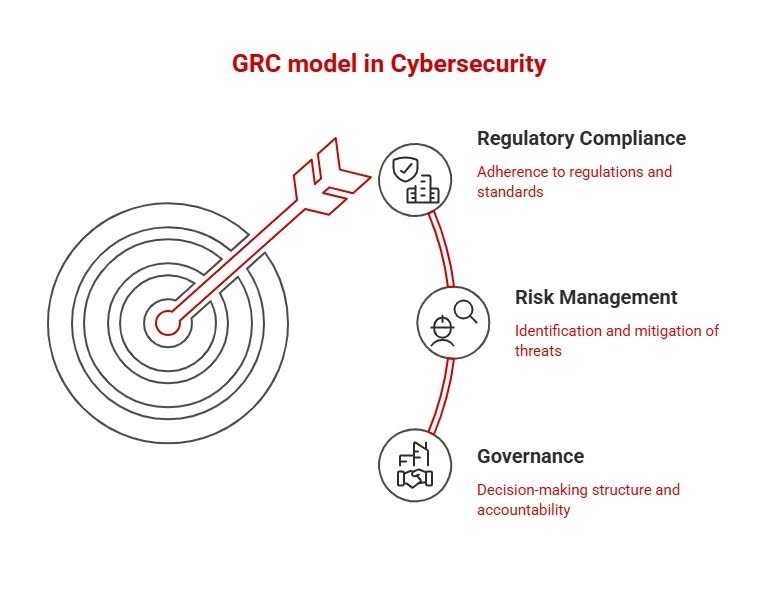
The acronym GRC stands for three concepts that, although they may seem independent, work in an integrated manner: Governance, Risk management, and Compliance.
The idea is not new, but it has gained traction as digital environments have become more complex and regulations have become more demanding. Cybersecurity GRC provides the framework to shift security from reactive to a strategic function within the organization.
Governance
Governance is the foundation of the model. It defines who is responsible for information security, how decisions are made, and which policies govern the organization’s behavior.
Without clear governance, cybersecurity becomes a no man’s land. Each department acts according to its own criteria, investments do not respond to a common strategy, and incidents are handled in an improvised manner.
Good governance implies, among other things, having documented policies, well-defined roles (from the CISO to the heads of each area), and periodic review mechanisms to ensure that decisions are aligned with the organization’s real context.
Risk management
Cybersecurity risk management seeks to answer a specific question: What threats is the organization exposed to, and what is their potential impact?
To respond effectively, it is necessary to identify assets, analyze vulnerabilities, assess the likelihood that different types of threats will materialize, and prioritize mitigation actions based on actual risk. Not perceptions, but data.
Compliance
Compliance encompasses the set of regulations, standards, and legal frameworks that an organization must adhere to. Depending on the industry and geography, this may include the General Data Protection Regulation (GDPR), the NIS2 directive, the National Security Scheme (ENS), sectorial regulations such as PCI-DSS for the financial sector, or frameworks such as ISO/IEC 27001.
Complying with these obligations is not only a legal issue. It also has a direct impact on the organization’s reputation and the trust of customers and partners. Non-compliance can result not only in significant financial penalties but also in reputational damage that is much more difficult to quantify and repair.
Why GRC cannot be a to-do list
One of the most common mistakes is treating GRC as a project with a start and end date. A policy is developed, an audit is performed, a certification is obtained… and then it’s over until the next cycle.
The problem is that the threat environment does not work like that. Vulnerabilities emerge constantly; attackers adapt their techniques; vendors change; employees rotate; and regulations evolve. What is controlled today may not be controlled tomorrow.
Therefore, modern cybersecurity GRC is oriented towards continuous monitoring and the ability to detect changes in exposure before they become problems.
CTEM: from risk management to continuous exposure
In recent years, an approach that complements and expands on traditional GRC has gained prominence: the Continuous Threat Exposure Management (CTEM).
The concept proposes that organizations should not simply assess their security posture on a regular basis, but maintain constant visibility of their attack surface: what assets are exposed, what data may have been leaked, what vulnerabilities are accessible from the outside, and how the organization is perceived from an attacker’s perspective.
This approach brings something fundamental to GRC: the ability to act on real, up-to-date risks, not snapshots that may have become obsolete in weeks.
How Kartos supports your organization’s GRC
This is where solutions such as Kartos by Enthec have a very specific role. Kartos is a platform for cyber surveillance designed specifically for companies that need to know, in real time, their exposure across open sources, the dark web, and the broader digital ecosystem.
Kartos enables security teams and GRC managers to access up-to-date information on exposed assets, compromised credentials, data leaks, and relevant mentions in hostile environments. All this without the need for intrusive operations and with a clear focus on decision-making.
Having this visibility is not a substitute for governance policies and compliance processes, but it makes them much more effective. It is difficult to manage well what you do not know.
Integrating GRC into the security strategy: Key Steps
Implementing a cybersecurity GRC framework does not require starting from scratch or unlimited resources. What it does require is clarity about the starting point and the willingness to structure the process.
Some elements that should not be missing:
- Updated asset inventory: You cannot protect what you do not know.
- Periodic risk assessments tailored to the organization’s actual context.
- Documented and communicated security policies at all levels. at all levels.
- Continuous exposure monitoring both internally and externally.
- Reporting mechanisms that connect cybersecurity with management and the board.
- Regular review of regulatory compliance, anticipating regulatory changes.
The key is that these elements do not work separately, but as part of a coherent system that feeds back into each other.
Want to know how Kartos can support your organization’s GRC framework with continuous visibility into your digital exposure? Contact us and find out what an attacker can see about your company before you do.