Enthec’s sensor network has been recording a surge in malicious activity since October 22–23: approximately 825,000 attacks per day, compared to 510,000 the previous week. We explained part of this increase in our article about a DDoS attack that uses exposed devices as weapons. Most of it, however, stems from another source: a credential-stealing campaign targeting Cisco ASA VPN access that, in just two weeks, has accumulated more than one million attempts against our decoys and is concentrated in Mexico and Brazil.
Why Is a VPN the Gateway to the Company?
Because it is the point through which the corporate network is accessed from the Internet. The VPN portal is used by remote workers and vendors—and, if left unguarded, by attackers as well.
Cisco ASA VPNs have long been in the crosshairs because of actively exploited vulnerabilities. In September 2025, the U.S. CISA even issued an emergency directive (ED 25-03) regarding two zero-day flaws in these devices. Our sensors show the other side of the problem: even if the device is patched, a weak or compromised password is enough to gain access.
What have Enthec’s sensors detected?
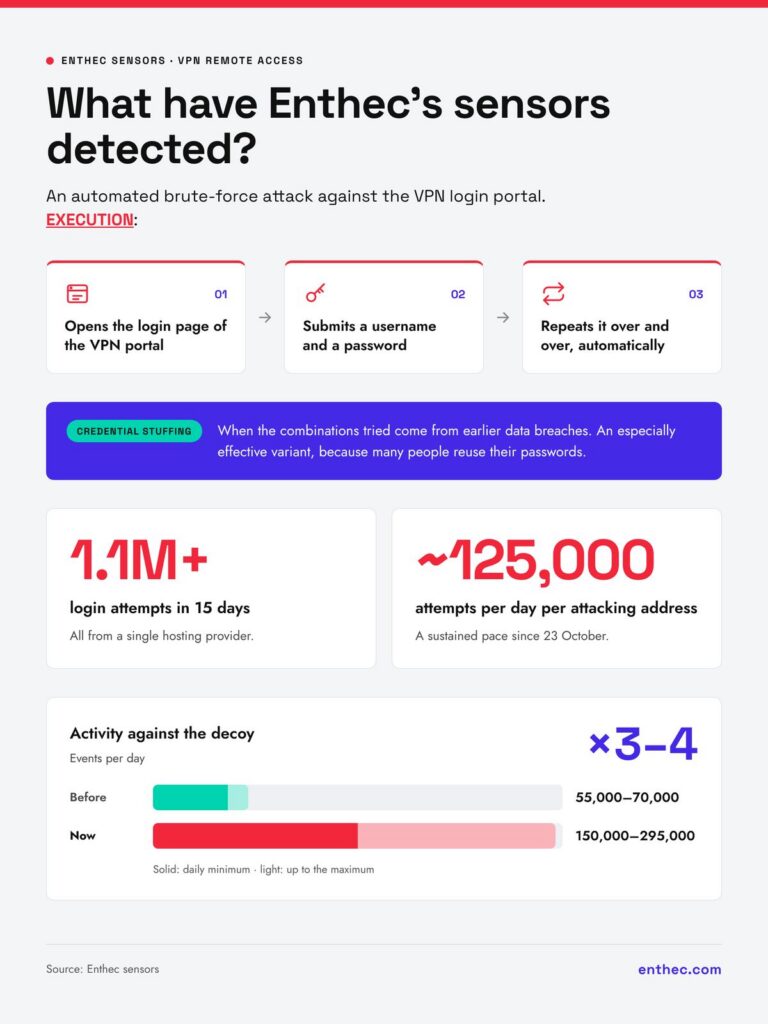
Each attempt follows the same pattern: the attacker opens the VPN portal’s login page and submits a username and password. Over and over again, automatically. It is a brute-force attack against remote access.
When the combinations being tested come from previous data breaches, this is known as “credential stuffing”, a particularly effective method because many people reuse their passwords.
- More than 1.1 million attempts in 15 days, all from a single hosting provider.
- Since October 23, the rate has been about 125,000 attempts per day per attacking IP address.
- Activity against the decoy simulating the Cisco ASA has increased three- to fourfold: from 55,000–70,000 events per day to 150,000–295,000.
How is the campaign organized?
What sets this campaign apart from a casual scan is its method. The attacker assigns a fixed IP address to each target and, when that address is “burned,” replaces it with another:
|
Period |
Source of the IP | Objective |
|
Oct. 13–14 |
Netherlands |
One IP for each Latin American decoy |
|
Oct. 15–23 |
United States |
One IP, against a decoy |
| Since Oct. 23 |
Germany |
Once again, a decoy IP address, ~125,000 attempts per day each |
This is how an industrial operation works: it is sustained over weeks, spread out so as not to arouse suspicion at any single point, and designed to continue operating even if one branch is shut down.
Europe, Off Target
The Enthec network has sensors in Europe and Latin America, and the European decoy exposes the same simulated Cisco ASA, on the same port, and operating in exactly the same way. It has received virtually no attempts.
The campaign chooses its targets: it focuses on sensors in Mexico and Brazil. It is not an indiscriminate sweep of the Internet, but rather a deliberate selection of targets by region. Just because an organization isn’t in the area of interest this week doesn’t guarantee it won’t be next week.
What does Proxmox have to do with all this?
On October 22, the SSH lure detected a reconnaissance script it hadn’t seen before. The first thing it checked was whether the system was a Proxmox—the virtualization platform that many companies use as an alternative to VMware—whether it was running FreeBSD, and whether it could gain administrator privileges without a password.
This is a small volume (36 attacks in a single day) and does not indicate a trend. However, it is consistent with a widespread ransomware technique—attacking the hypervisor—because encrypting a single machine takes down all the virtual machines it hosts. Two of the hosting providers from which that script was launched also appear among the sources of traffic targeting the Cisco decoy.
What should you check to improve VPN security?
- Two-factor authentication for the VPN, with no exceptions for service or vendor accounts.
- Check for corporate credentials leaked in data breaches, forums, or dark markets: these are the first ones to be tested. Implement robust password management so a breach at another service doesn’t grant access to the VPN.
- Limit login attempts and alert to spikes in failed attempts, not just successful logins.
- Don’t rely solely on IP blocking: the campaign is designed to replace every blocked address.
- Restrict access by source when actual VPN usage allows it.
- Keep your equipment up to date and review Cisco security advisories.
See what’s happening out there
A campaign like this isn’t seen from within a single company; it’s seen as just another failed attempt among many. Enthec’s network of sensors allows us to observe it in its entirety—its pace, its method, and its selection of targets.
And the Kartos platform lets each organization see which portals are exposed to the Internet and whether their credentials are already circulating outside their control, before anyone tries to use them on their VPN. Developed in Spain, in compliance with European regulations, and supported by a Spanish-speaking team for organizations in Latin America.
Contact us to see what an attacker sees when looking at your company from the outside.