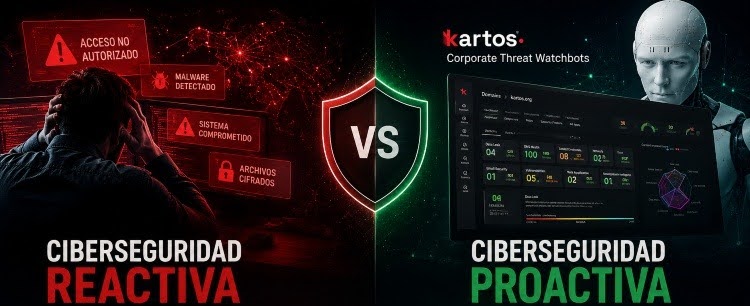
A company detects unauthorized access to its network on a Tuesday morning. The IT team spends the next 48 hours putting out fires, isolating servers, reviewing logs, and explaining to management what happened. That is reactive cybersecurity in its purest form: responding after the damage has already been done.
Proactive cybersecurity raises a different question. Instead of asking, “How do we fix this?”, ask, “How did we know this could happen, and why didn’t we act sooner?” The difference may seem semantic, but it completely changes the cost, impact, and reputation associated with an incident.
What Exactly Is Reactive Cybersecurity?
Reactive security is based on detection and response after the fact. An antivirus program that blocks malware after it has already been executed, a SOC that analyzes an alert after the attack, a recovery plan that is triggered once the ransomware has already encrypted files. It’s not useless—far from it—and without these layers, any incident would be much worse.
The problem is that this model assumes the attack will occur first and the defense will react afterward. And it is during that window of time—between when the attacker gains access and when the company becomes aware of it—that almost all of the actual damage occurs: data theft, lateral movement across the network, and extortion.
The IBM study (Cost of a Data Breach Report 2026) estimated the average time to identify and contain a breach at 247 days. That’s more than eight months during which an attacker can move freely within a company’s systems, while the company remains unaware that it has been compromised.
What Changes with a Proactive Approach
Proactive cybersecurity doesn’t wait for an alert. It looks for the conditions that make an attack possible before anyone can exploit them—such as credentials leaked on forums, unpatched vulnerabilities, fraudulent domains impersonating the brand, and exposed digital assets that no one even remembers exist.
This requires something that many companies still lack: continuous visibility into their own exposure, not just a one-time snapshot once a year. A penetration testing The annual report describes the security status on the day the test was conducted. Three months later, that photo is no longer useful, because the infrastructure, vendors, and exposed credentials change every week.
This is where the concept of continuous threat exposure management. It is, quite simply, a shift in approach: it involves moving away from hunting down vulnerabilities one by one and instead continuously managing everything an attacker could see and exploit from the outside.
| Reactive Cybersecurity | Proactive Cybersecurity | |
| When it takes effect | After the incident | Before it happens |
| What it detects | Alerts and damage that has already occurred | Exposures, leaks, and potential attack vectors |
| Frequency | On-demand | Continuous, 24/7 |
| Cost of Failure | High: rescue, recovery, reputation | Low: Risk is addressed before damage occurs |
| Real-life example | SOC analyzes a post-attack alert | Kartos detects leaked credentials before they are used |
| Main limitation | By the time it takes effect, the damage has already been done | Requires investment in continuous monitoring |
Why the Difference Matters to the Business, Not Just to IT
Let’s be straightforward here: the debate between reactive and proactive approaches is not just a technical discussion confined to the IT department. It is a business decision with a direct impact on the income statement.
A security incident doesn’t just cost the amount of the ransom or the cost of technical repairs. It costs in downtime, customers switching to competitors, fines if personal data is involved, and trust which takes years to rebuild. Being proactive does not eliminate the risk, but it does drastically reduce the window of time during which an attacker can operate undetected.
Furthermore, there is an economic argument that many executives overlook: prevention is cheaper than remediation, and in cybersecurity, the difference is enormous. Hiring continuous cyber monitoring costs a fraction of what it costs to manage a data breach that has already occurred—including lawyers, crisis communications, and upset customers.
How Continuous Exposure Management Is Applied in Practice
The theory behind CTEM is all well and good, but what really matters to a company is how it translates into day-to-day operations. At Enthec, that’s exactly what we focus on, with Kartos, our continuous cyber monitoring platform for businesses.
Kartos constantly monitors what an attacker would see if they decided to investigate an organization. Among the vectors it continuously monitors are:
- Credentials leaked on the dark web: employee usernames and passwords exposed on illegal forums or marketplaces before anyone can use them.
- Fraudulent domains: domain registrations similar to the company’s, intended to impersonate the corporate identity or deceive customers.
- Vulnerabilities in public services: open ports, outdated services, or insecure configurations visible from outside the perimeter.
- Sensitive information exposed: internal code, documents, or data that have ended up in public repositories or third-party forums without anyone noticing.
For personal use, Enthec offers Qondar, designed for executives, at-risk professionals, or anyone who wants to know if their digital identity, credentials, or personal data have ever been compromised. The logic is the same as in Kartos, adapted for an individual rather than an entire organization.
The two approaches are complementary
It would be a mistake to frame this as an either/or choice. No serious company would eliminate its ability to respond to incidents. What changes with a proactive system is the starting point: rather than the attack itself being the first warning sign, the company already knows where it is vulnerable and has been able to close those doors in advance.
The ideal combination is clear. Maintain a capacity to respond when something slips through the cracks (because it always happens) and combine that with continuous monitoring to keep the list of “somethings” as short as possible.
Organizations that invest only in reactive measures spend their time putting out fires without asking themselves why they keep happening. Those who invest only in prevention without a response plan are in for some unpleasant surprises when something they didn’t see coming goes wrong.
The Real Cost of Waiting
Let’s go back to the example from the beginning. That company that discovered the unauthorized access on a Tuesday morning had likely been exposed for weeks or months without realizing it.
If your company still manages cybersecurity solely on a reactive basis, it’s worth asking yourself how much of your actual exposure you’re unaware of right now. An initial assessment of your exposure surface using Kartos is usually enough to answer that question with concrete data, not assumptions.
Frequently Asked Questions
Does proactive cybersecurity replace antivirus software or firewalls?
No. They are complementary layers. Antivirus software and firewalls are still necessary as internal barriers; proactive monitoring provides visibility into what is happening outside the perimeter, before that risk reaches those barriers.
Is CTEM the same as a penetration test or a security audit?
Not exactly. A penetration test assesses security at a specific point in time. CTEM involves continuous monitoring, with constant updates to the attack surface—not a snapshot that becomes outdated within weeks.
What size of company needs continuous cyber monitoring?
Any organization with a significant digital presence, employees with corporate credentials, or customer data to manage. The risk depends not only on the organization’s size, but also on its surface area and how attractive that information is to an attacker.
How much does it cost to implement proactive cybersecurity versus reactive cybersecurity?
The cost of continuous monitoring is significantly lower than that of managing a breach that has already occurred. According to the IBM Cost of a Data Breach Report 2026, the average cost of an incident exceeds $4.99 million globally. Investment in preventive monitoring typically represents a fraction of that figure.