


Passive cybersecurity attacks: Keys to identifying these types of invisible threats
When discussing cybersecurity, we often imagine exaggerated and obvious attacks: viruses that lock your computer, malicious emails demanding ransoms, or fake websites trying to steal your passwords. However, other types of threats are much more silent, but equally dangerous: the passive attacks in cybersecurity.
These attacks sneak in, watch, and wait. And that's precisely why they're so difficult to detect. In this article, we'll unravel what they are, how they work, and, most importantly, what you can do to protect yourself, whether you are a company or browsing as a private user.
What is a passive attack in cybersecurity?
In cybersecurity, a passive attack is one in which the attacker does not directly interfere with the system's operationbut rather simply spies, gathers information, or monitors network traffic without detection. Unlike active attacks, which seek to modify, damage, or control a system, passive attacks act as invisible observers.
Some typical examples of this type of threat include:
- Packet sniffing on public or poorly protected networks.
- Passive tracking to obtain browsing habits or device data without the user's consent.
- Monitoring encrypted communications, waiting for vulnerabilities to exploit in the future.
These attacks may seem less aggressive, but the information they collect can later be used for targeted attacks, blackmail, or impersonation.. In addition, many cybercriminals use this data as raw material to sell on the dark web.
Why are passive attacks so dangerous?
The main problem with passive cybersecurity attacks is that they go unnoticed for long periods.. They don't generate any prominent warnings, and in many cases, the victim won't even know they've been spied on.
This allows the attacker to:
- Gather detailed information about his objectives (IP addresses, browsing habits, credentials, etc.).
- Wait for the best moment to act (for example, to launch a follow-up active attack).
- Design social engineering campaigns that are highly personalized and effective.
That is to say, a Passive attack is the first silent step before a more decisive blow.
Passive cybersecurity: a contradiction?
The term passive cybersecurity can be confusing. It sometimes refers to measures that don't act directly on a threat but merely observe or record it. However, when discussing in cybersecurity, passive tracking refers to monitoring a malicious actor's actions without directly intervening in the systems.
We must not confuse legitimate surveillance with malicious spying. Today, many platforms monitor user behavior to offer personalized services. But when this monitoring is carried out without consent, for opaque purposes, or by external actors, it goes from legitimate to dangerous.

How to detect a passive attack: Main signs
Detecting a passive attack can be tricky,but it's not impossible. Some signs can help you identify that something isn't right:
1. Unusual activity on your networks or devices
If you notice a strange use of bandwidth, suspicious connections, or unexpected encrypted traffic, it may be a sign that someone is listening.
2. Too many coincidences
If you start receiving very personalized phishing campaigns, messages with details that should only be known by legitimate sources, or targeted attacks, someone may have been collecting information before without realizing it.
3. Cybersecurity tool alerts
Good security systems don't just act against active attacks. Some advanced threat management systems, like the ones we offer from Enthec, allow you to identify suspicious patterns even in quiet environments.
How to protect yourself? The importance of continuous cyber surveillance
In a world where threats don't always make noise, prevention becomes your best ally,. and this is where a key concept comes in: Continuous Threat Exposure Management (CTEM).
This approach is not only based on responding to attacks when they occur but also on constantly monitoring what information is being exposed without your knowledge.. Because others may be seeing your data even if you don't.
Qondar, your silent shield against invisible threats
Qondar, one of our cyber surveillance solutions, is designed for private users. who want to know what information about them is appearing and circulating on the internet. Has your email been leaked on dark web forums? Has one of your passwords been shared without your knowledge? Is someone impersonating you digitally?
Qondar answers these questions with regular reports, personalized alerts, and a constant monitoring system that lets you sleep more peacefully, knowing that someone is watching over you.
One of the most interesting advantages is that Qondar doesn't need access to your devices or keys.. It works from the outside, watching the net like a passive attacker would, but to your advantage.
What if I've already been spied on?
If you suspect you've been the victim of a passive attack, you first must strengthen your passwords, enable two-factor authentication, and audit your digital presence.
Tools like Qondar allow you to do just that: see what footprints yours are exposed to and which ones others may be taking advantage of. Acting quickly is essential.. The sooner you identify a leak or vulnerability, the less likely it is to become an active attack.
Just because a passive cybersecurity attack doesn't directly damage your systems doesn't mean it's not serious. On the contrary, its invisibility makes it a real threat that can go undetected for months.
Monitoring what others see about you is essential to protecting your digital identity. That's why it's so important to have tools like Qondar, which allow you to manage your digital exposure proactively, easily, and effectively.
Don't leave your safety to chance. Start monitoring your digital footprint with Qondar today and discover if someone is spying on you without your knowledge.

Cybersecurity in hospitals: How continuous monitoring protects sensitive patient data
Medical information is as valuable as it is sensitive. Hospitals and health centers, traditionally focused on caring for people's physical and emotional health, today face a new challenge: protecting their patients' sensitive data.
Every medical record, diagnostic report, and treatment stored in a digital system represents critical information. Its exposure, theft, or alteration compromises privacy and can endanger human lives. Therefore, cybersecurity in hospitals has become a strategic priority.
The risk is real: why are hospitals targeted?
If you've ever wondered why someone would attack a hospital, the answer is more straightforward: medical data is worth a lot on the black market.. In addition, health centers often have complex, usually outdated computer systems, which makes them relatively easy targets for cybercriminals.
According to data from SonicWall's Global Threats Report (2025), the health sector was among the most attacked during the year. 95% of ransomware was used in attacks on the industry, and more than 198 million patients were affected in 2024 alone in the United States.
Spain is no stranger to this reality: public and private hospitals have suffered leaks, data hijackings, and service outages that have directly affected healthcare.
These cybersecurity attacks in hospitals not only involve economic and reputational losses.. On many occasions, they force us to delay operations, refer patients, or go back to using paper, with all the complications that this entails.
What does it mean to protect a hospital?
In the current context, cybersecurity can no longer be understood as a set of isolated measures implemented once and forgotten. Attacks evolve, techniques change, and exposure to threats is constant.
For this reason, more and more healthcare organizations are adopting models such as CTEM (Continuous Threat Exposure Management), or in Spanish, Continuous Threat Exposure Management. This strategy is based on actively and permanently monitoring all possible attack vectors: from network configurations to exposed credentials or known vulnerabilities.
This is where Kartos,our specialized cyber-surveillance solution for organizations, comes into play. Kartos allows hospitals and health centers to have a clear and up-to-date view of their exposure to cyber threats, analyzing their digital footprint in real time and alerting them of any possible risk before it is too late.
The importance of continuous surveillance in the hospital environment
A hospital environment is much more than doctors, nurses, and patients. There are dozens of connected devices, from monitors to respirators, internal management systems, databases, emails, and mobile applications. Each of these elements can be a gateway if not adequately protected.
The continuous monitoring offered by Kartos acts as an early warning system. It identifies vulnerabilities and tracks information leaks,leaked passwords, possible domain impersonations, or suspicious network activities. It does so without installation since it works outside, analyzing the healthcare organization's public exposure.
This proactive approach does not replace other layers of defense (such as antivirus, firewalls, or access policies). Still, it complements them, providing a fundamental angle: Know how attackers see you and act accordingly.
Thanks to this type of surveillance, Hospitals can make informed decisions in advance, instead of just reacting when it's too late.

And what about regulatory compliance?
In addition to protecting sensitive data, Cybersecurity in hospitals is also a legal issue.. Regulations such as the General Data Protection Regulation (GDPR) or the NIS2 Directive require healthcare organizations to implement protection measures and demonstrate that they have taken appropriate actions to prevent security breaches.
Solutions like Kartos are especially useful here. They allow hospitals to continuously record threat exposure and implement corrective actions, which enhances security and facilitates audits, inspections, and certification processes.
Cybersecurity in hospitals: defense against attacks, but also prevention
A good defense is not only based on building walls, but also on knowing where attackers can enter. In a healthcare environment, where people's lives are at stake, prevention is as important as the response.
Adopting efficient solutions allows hospitals to act before a crisis occurs.. The best thing is that they do not require complex integrations or changing how IT teams work since the tool operates from the outside, with total autonomy.
Enthec, a company specialized in cyber surveillance, offers technology and strategic support to anticipate risks and maintain constant vigilance.
The human and technological challenge
Awareness of healthcare personnel is also key.. Many security breaches begin with clicking on a malicious link or using a weak password. Therefore, cybersecurity solutions must be part of the hospital culture, as hygiene or patient care are.
Kartos helps in that process by offering precise and actionable reports that allow training internal teams, prioritizing efforts, and establishing more effective security policies.
Hospitals are places of care; we cannot allow digital threats to compromise operations. Cybersecurity in hospitals is neither a luxury nor a fashion but an urgent need that must be addressed with modern tools, strategic vision, and constant commitment.
Kartos provides real-time vision that allows hospitals to anticipate problems and keep patient data where it should be: safe, secure, and available only to those who need it.
Do you want to know how to better protect your hospital against digital threats? Find out more about our Kartos solution.
Enthec obtains ISO 27001 International Certification
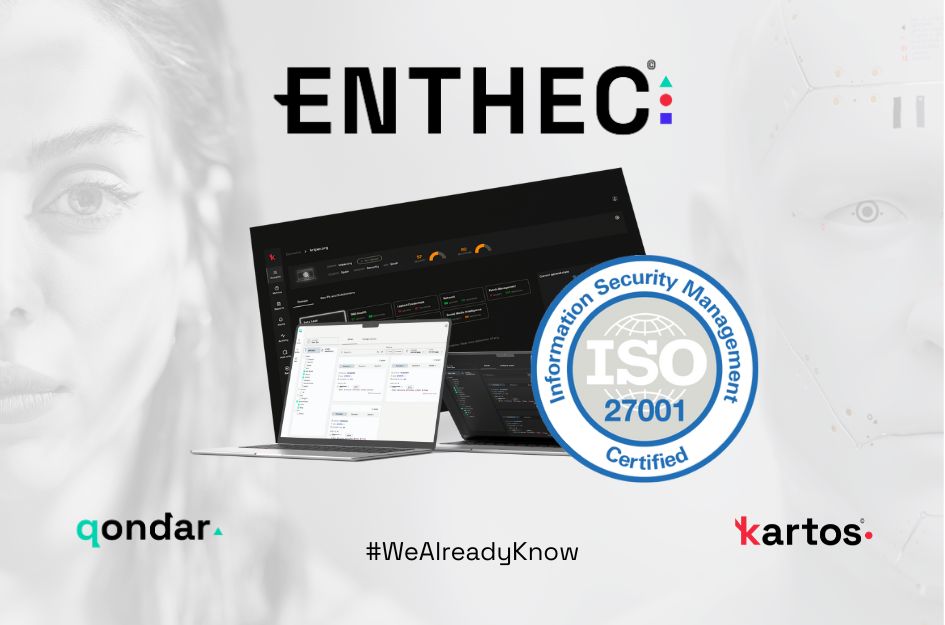
Continuing with our philosophy of ensuring the protection of our clients and partners, we are proud to say that Enthec Solutions has completed the ISO 27001 certification process, which AENOR handled. This international certification allows us to offer better security standards to our clients.
ISO 27001 is a globally recognized information security standard developed and maintained by the International Organization for Standardization (ISO). It focuses on providing an information security management system (ISMS) specification.
Organizations using an ISO 270001-compliant ISMS ensure compliance with various laws regulating information security, including the GDPR and the Network and Information Systems Regulations, or MIS regulations.
Since our beginnings, Enthec Solutions has been committed to the security of our clients as the basis of trust in the business relationship, both in our advanced offer of cybersecurity solutions and in our own company.
This commitment is fulfilled, on the one hand, thanks to the absolute control of the development and operation of our solutions: our entire offer is made up of cybersecurity solutions that use technology developed entirely by our team and without back doorssince they do not depend on third parties at any time. A characteristic that makes us unique within the cybersecurity software development sector. On the other hand, it can be done through the most prestigious national and international security certifications, such as the ENS High Level or ISO 27001.
Once this new certification process is completed, at Enthec Solutions, we will continue seeking the most advanced paths to protect our company and develop the most advanced technology solutions to protect our clients.

Due Diligence in cybersecurity: How to protect your company during an audit?
The word 'audit' usually causes some tension in any company. Whether for legal, financial, or technical reasons, any external review necessitates a critical examination of our processes.
And when we discuss cybersecurity audits,the tension escalates. Are we protected? Do we know where our weaknesses are? What if the auditor finds an open door?
This is where cybersecurity due diligence comes into playan essential process to prepare your company for this type of evaluation. Beyond legal compliance, it is about protecting critical assets, reputation, and, above all, the trust of your clients and partners.
What is cybersecurity due diligence?
When a company undergoes a due diligence audit, whether for an investment, a merger, or to comply with regulations, one of the key aspects that is analyzed is the state of its cybersecurity.. Internal policies, incident response protocols, network configurations, and the storage of sensitive data are reviewed, among other relevant aspects.
Due diligence seeks to identify risks before they become problems.. In the digital context, this means detecting web vulnerabilities before an attacker does.
For example, typical examples of due diligence may include reviewing the security of connected devices (IoT), analyzing remote access, protecting personal data, or ensuring the company's visibility on the dark web.
Now, how can an organization prepare so that this review does not become an endless list of failures?
Before the audit: visibility and prevention
This is where tools like Kartosby Enthec play a fundamental role. This is a Continuous Threat Exposure Management (CTEM) solution designed for companies that want to know, in real-time, what attack surface they are presenting to the world.
That is, what information, configurations, or failures are visible from the outside, in the same way that a potential attacker or auditor sees them.
And this is no small thing. During the due diligence process, one of the most common mistakes is relying solely on internal measures or static reports.. However, threats evolve daily, just as a company's digital footprint does.
Kartos enables continuous monitoring, detecting everything from leaked passwords to exposed services, poorly configured repositories, and even vulnerabilities in IoT devices, such as surveillance cameras, sensors, and routers.
What can (and cannot) a due diligence audit detect?
In the same way that a penetration test, or pentesting, occurs,traditional cybersecurity due diligence has a limited scope. Although it allows you to identify technical, regulatory, or process risks at a specific point in time, it does not provide a continuous or dynamic view of the company's actual exposure status.
It's like taking a static photo of a network at a specific moment. However, the threats persist, and the attack surface evolves with each new configuration, vendor, employee, or service that comes online.
This is where Kartos shines.. This tool detects which weaknesses can be seen from outside in real time:
- Leaked credentials in databases or forums.
- Misconfigured utilities or exposed.
- Forgotten subdomains or without protection.
- Expired digital certificates.
- Known vulnerabilities in systems accessible from the Internet.
- Information that is visible in open sources and on the dark web.
But the most important thing is not only what it detects, but what due diligence cannot detect if it is not complemented. Without continuous monitoring, any audit becomes obsolete the moment it is completed.
Therefore, the due diligence process needs to be supplemented with tools like Kartos to cover the remaining risk areas. Only in this way can we speak of a complete vision.
Why do IoT vulnerabilities escape traditional due diligence?
One of the most common blind spots in due diligence audits is the Internet of Things (IoT) devices. Cameras, sensors, printers, and routers are all integral components of a company's digital ecosystem; however, many of them are not properly audited or managed.
And this is a problem. According to data from Kaspersky (2023), attacks on IoT devices grew by 41% in a single year.. Many of them exploited default passwords, outdated firmware, or open ports that had not been checked.
The most worrying thing? These types of errors are not always visible during a traditional due diligence process, especially if they are not integrated into a clear policy or are not part of the official inventory.
With Kartos, these elements are brought into focus, as the tool analyzes what is visible from the outside, just as an attacker or external researcher would do.. This allows critical input vectors to be detected before they generate an incident… or before an auditor flags them as a serious threat.
What does the cybersecurity due diligence process include?
Although it varies depending on the type of audit, a typical process usually includes:
1. Document review
Security policies, contingency plans, internal training, and other relevant measures. Here we analyze whether the company has clear rules and applies them.
2. Technical analysis
Network scans, log reviews, malware detectionpenetration tests, and more. In this phase, fundamental weaknesses are detected.
3. Exposure assessment
This point is key and often ignored. It attempts to analyze what information is visible from the outside, such as external access, open services, and data leaks. Precisely, Kartos' strong point.
4. Risk assessment
With all of the above, a risk map is generated that enables informed decisions to be made, such as reinforcing measures, prioritizing investments, or even pausing operations if the level of exposure is extremely high.
You may be interested→ Cybersecurity risk management for C-levels.
What are the benefits of getting ahead of the audit?
Preparing ahead of time not only reduces stress but also enhances the company's position with investors, partners, or buyers.. Additionally, it allows:
- Anticipate problems before third parties detect them.
- Enhance your security posture without last-minute rushes.
- Increase confidence in strategic business decisions.
And above all, it transmits an image of technological maturity, which in 2025 is more critical than ever.
Enthec: ally during the due diligence process
Enthec not only offers cybersecurity solutions like Kartos (for companies) and Qondar (for individual users), but also provides tranquillity. The possibility of knowing, at any time, how exposed your organization is. To receive alerts before the media does. To anticipate, instead of react.
Because in cybersecurity, information is power, but continuous monitoring is a matter of survival.
If you are preparing an audit or want to assess the visibility of your weaknesses, it's time to talk to Enthec.
Cybersecurity audits are not a luxury, but a necessity. Due diligence should not be seen as a threat, but rather as an opportunity to strengthen our systems, learn from our weaknesses, and demonstrate to the market that we are prepared.
Because, ultimately, it is not just about passing an audit, but about building a safe, solid, and sustainable company.

IoT and cybersecurity: Risks and strategies to protect connected devices
We live in an era where everything is interconnected. From our smart watches to the home thermostat, including surveillance cameras, speakers, locks, and even the refrigerator. This interconnection, known as the Internet of Things (IoT), makes our lives easier in many ways.
Cybersecurity in IoT, is, today more than ever, a real need. The exponential growth in the number of connected devices has led to an increase in vulnerabilities and attacks.
It's not just about protecting personal data; we're also talking about physical security, privacy, business reputation, and even operational continuity in companies that rely on IoT for their processes.
Cybersecurity in IoT is not optional
According to a Kaspersky report, in the first half of 2023, there was a significant increase in threats targeting IoT devices, including DrDoS attacks, DDos, ransomware, and other types of malware that exploit common vulnerabilities such as default passwords and insecure network services.
And that's just the tip of the iceberg. Many devices are not correctly configured, use weak passwords, or continue to run on outdated software.
One of the biggest mistakes is assuming that an IoT device is harmless because it does not store sensitive data. But it only needs to be connected to the same network as other, more critical equipment for it to become a gateway to the system.

What types of vulnerabilities are common in the IoT?
The threats affecting the IoT ecosystem are varied, but many share a familiar pattern: lack of basic protection.. Some examples:
- Default passwords.. Many IoT devices come with factory credentials that users never change.
- Unnecessary open ports.. Access that allows attackers to explore and manipulate the device easily.
- Non-existent or manual updates.. Many manufacturers do not offer automatic updates, leaving their devices vulnerable to known security flaws.
- Unencrypted communication.. Some devices transmit information in plain text, making it easier for third parties to intercept and read the data.
- Poor network segmentation.. Using the same network for IoT devices and personal computers or servers makes it easier for a breach to affect the entire system.
The importance of a global vision: IoT cybersecurity in companies
In the business environment, these vulnerabilities can have a devastating impact. Let's consider a factory that automates processes using sensors, cameras, and interconnected equipment. A single compromised device can paralyze production or leak strategic information.
This is where having advanced surveillance and threat analysis tools, such as Kartos, Enthec's business solution, is crucial.. Kartos enables you to identify vulnerabilities, such as leaked credentials on the dark web, exposed devices, or data leaks related to the company's connected assets.
Kartos provides Continuous Threat Exposure Management (CTEM), offering a real-time, updated, and comprehensive view of the company's exposure level.
Kartos not only detects but prioritizes the most relevant risks for the business and recommends concrete actions to mitigate each threat. This is especially useful for IT and cybersecurity managers, as it allows them to make quick and informed decisions.
Do you want to know your company's level of exposure in real-time? Contact us to discover how Kartos can help you protect your IoT infrastructure from exposed leaks and open breaches.
IoT risks: beyond data
Security in IoT extends far beyond preventing information theft. Some of the IoT risks most relevant include:
- Unauthorized access to security cameras that can be used for spying or blackmail.
- Manipulation of sensors or automated systems, generating interruptions or physical damage.
- Using devices as bots in massive attacks (DDoS) without the user being aware.
What can we do? Strategies to improve cybersecurity in IoT
Basic measures that every user should adopt
- Change default passwords and use strong keys.
- Update the firmware of devices regularly.
- Disable unused features, such as remote administration.
- Separate the networks, creating an exclusive network for IoT devices.
- Review the permissions and access of each team.
Strategies for companies
- Inventory all IoT devices connected to the network.
- Implement cybersecurity solutions and cyber surveillance tools, such as Kartos, which identify exposed devices and leaks in real-time.
- Apply network segmentation policies to isolate vulnerable devices.
- Establish strong access controls and multi-factor authentication.
- Continuously monitor exposure to external threats, without relying solely on periodic audits.
And private users?
We cannot forget that homes are also increasingly complex IoT environments. For them, Enthec has developed Qondar, a customized CTEM solution for individuals.
Qondar enables anyone to verify if their credentials have been compromised, if their devices are publicly exposed, and even, beyond IoT technology, if there is any trace of their digital identity circulating in insecure environments. A handy tool for enhancing privacy and safeguarding against malicious uses of information and emerging technologies, such as IoT.
Prevention is cheaper than disaster
Investing in IoT cybersecurity is not an expense, but a wise investment.. The costs derived from a security breach (reputational damage, business interruptions, legal sanctions...) can far exceed any budget allocated to protection.
Additionally, being one step ahead in risk management allows companies to innovate with confidence, knowing that their digital environment is protected. And that translates into a competitive advantage.
Digital transformation is here to stay, and the Internet of Things (IoT) is a crucial component of this change. However, every new technology comes with its own set of risks. Shielding security in IoT should be a top priority for both companies and individuals.
Solutions like Kartos and Qondar by Enthec stand out in the way we manage those risks. It's not just about protecting devices: it's about protecting everything behind them.
Do you want to start protecting your connected devices today?
Discover how Enthec can assist you with tailored solutions that meet your specific needs.

The importance of cloud security in protecting your data
Personal and professional data has become one of the most valuable assets. We are not just talking about documents, photos, or emails, but sensitive information, contracts, bank details, business plans, and strategies. In most cases, all of this is stored and managed in the cloud.
However, this convenience has its counterpart: cloud security risks. They are not a simple possibility but a reality affecting companies and individuals. Protecting our data against digital threats is an urgent need, not a technological luxury.
Before getting into the matter, you should know Kartos, our solution for companies that want to maintain control over their cybersecurity. Kartos is a Continuous Threat Exposure Management (CTEM) solution that constantly monitors an organization's digital environment and detects vulnerabilities before they become a real problem.
What exactly is cloud security?
When we talk about cloud security, we refer to the set of technologies, policies, controls, and procedures that protect systems, data, and infrastructure hosted on cloud platforms.
That is, it is not just about using strong passwords but about ensuring that the cloud service provider, configuration, and users act safely and consciously.
Here, we have everything from encryption systems to access control practices, threat detection, and incident recovery plans.
How does cloud security work?
Cloud security operates at several levels:
- Infrastructure layer: where the hardware and physical servers on which the cloud resides are protected.
- Network layer: responsible for monitoring data traffic and preventing unauthorized access.
- Application layer: This guarantees that the applications do not have flaws that allow attacks.
- Data layer: where encryption, authentication, and backup tools are implemented.
In addition, there are specialized tools that go beyond static protection, as is the case with our solutions, which work under an active cyber surveillance model. This means that they not only protect but also constantly monitor and evaluate the level of exposure to digital risks.

Why should we take cloud security risks seriously?
Cyber attacks are a reality. According to an IBM study published in 2023, the average cost of a cloud security breach is $4.35 million.. And it's not just large companies that are frequent targets: SMEs and individual users are also frequent targets precisely because they tend to have laxer security measures.
Some of the top cloud security risks include:
1. Unauthorized access
Poor permission management or weak passwords can give cybercriminals access. This is especially serious if the data involved is personal, financial, or confidential.
2. Data loss or leak
Cloud systems can be misconfigured, exposing files. Sometimes, user data has been published inadvertently due to human error or technical oversights.
3. Ransomware attacks
In these attacks, criminals encrypt files stored in the cloud and demand a ransom to release them. Staining that data may be impossible without a good backup and discovery strategy.
4. Misuse of resources
Sometimes, attackers do not seek to steal data but instead use the infrastructure to mine cryptocurrencies or launch other attacks from our account, thus compromising the reputation and resources of the organization.
How to protect yourself: keys to a good cloud security strategy
It is not enough to have good faith or trust that “it won't happen to me.” Prevention is the only effective barrier against threats. Here are some basic recommendations:
Choose trusted suppliers
Not all cloud platforms offer the same level of security. Ensure the supplier complies with regulations such as ISO 27001 o GDPRand has clear incident protocols. A third-party risk assessment, like the one allowed by Kartos, is key to protecting your value chain and preventing someone else's weakness from compromising you.
Monitor your exposure
This is where a solution like Kartos is beneficial. Through active external attack surface (EASM) management,Kartos detects exposed assets, vulnerable configurations, or spoofed domains. This allows anticipation phishing or brand impersonation campaigns, which are common in targeted attacks.
Use strong passwords and multi-factor authentication
It seems obvious, but even today, many credential leaks start with a weak or reused password. If you can, enable two-step authentication on all services. Kartos can detect when your credentials are exposed on dark web forums or markets.
Make regular backups
If your information disappears or is hijacked by ransomware, the best way to protect yourself is to have an up-to-date, secure copy. Although Kartos does not replace backup, its constant monitoring helps detect anomalous activity before attacks, which can give you time to act.
Educate your team
Many times, the weakest link in the security chain is the human. One click on a fake message on social networks or a cloned website can be enough to land you in a phishing, fraud, or identity theft campaign.
Enthec's role in your digital security
In this scenario, Enthec is not just a technology solutions provider. It is a strategic ally in cyber surveillance and active protection. Its CTEM approach allows continuous monitoring of the status of your cybersecurity, offering quick and effective responses.
Through Kartos, designed for companies, you can evaluate each exposed vulnerable point of your digital infrastructure. This tool helps you make informed decisions and act before a problem exists.
Cloud security is your responsibility
It is easy to think of the cloud as an intangible and harmless space. But the truth is that, like any place where value is stored, it has dangers. Cloud security is not optional but an investment in peace of mind, reputation, and continuity.
Solutions like those offered by Enthec, with its proactive approach tailored to businesses and individual users, put you several steps ahead of cybercriminals.
Don't wait for something to fail to act. Start protecting your data with Enthec today.
NIS 2: How does it affect companies, and what measures must be taken to comply with the regulations?
In an environment where cybersecurity has become critical for business survival, the entry into force of the NIS 2 Directive marks a before and after for hundreds of organizations in Europe.
This is not a recommendation or a simple guide to best practices: NIS 2 is mandatory and requires companies to protect their systems, data, and services against increasingly complex threats.
But what exactly does this directive imply? How does it affect companies in Spain, and which sectors must comply with it? Above all, how can an organization adapt without being overwhelmed by technical complexity?
This article explains everything clearly and shows how tools like Kartos by Enthec can help you take that step safely and effectively.
What is the NIS 2 Directive?
The NIS 2 Directive (Network and Information Security) is the evolution of the first NIS directive, approved in 2016. It was created to improve the resilience of essential services to cyberattacks. resilience of essential services to cyberattacks.
However, the first version was reduced due to the evolving threat landscape. That's why the European Union published the new NIS 2 Directive in January 2023, significantly expanding its scope and requirements.
What changes with NIS 2?
- The number of affected sectors is expanded.
- Security and notification obligations are tightened.
- Penalties for non-compliance are increased.
- Cybersecurity governance and oversight in member countries are strengthened.
NIS 2 regulates and demands active company responsibility, incorporating continuous surveillance, prevention, and threat response measures.
Which companies are affected by NIS 2?
One of the key points of this regulation is its expansion of the scope of application.. It is no longer limited to large critical infrastructures such as electricity, transport, or health. No,w it also includes medium and large companies in sectors such as:
- Information and communication technologies (ICT)
- Chemical and food manufacturing
- Water, waste, and digital services management
- Cloud service providers, data centers, DNS, and domain registries
According to INCIBE estimates, more than 12,000 entities in Spain could be affected by the NIS 2 regulation.. Many of them, especially tech SMEs, have not yet started to prepare.
What does NIS 2 require of companies?
Complying with NIS 2 is not just a matter of software or firewalls;it involves a comprehensive approach that affects the organization at multiple levels.
Among the main requirements, the following stand out:
Technical and organisational measures
Enterprises must implement appropriate security controls, from network segmentation and vulnerability management to access policies or data encryption.
Ongoing risk assessments
Regulations require regular analyses and assessments of risks associated with the security of networks and systems.
Obligation to report incidents
In the event of a significant incident, the company must inform the competent authorities within 24 hours, which requires having effective detection and response systems.
Governance and accountability
Senior management must be actively involved in the cybersecurity strategy. Responsibility cannot be delegated solely to technical teams.
Sanctioning regime
NIS 2 introduces penalties that can reach up to €10 million or 2% of global annual turnover, making compliance a strategic necessity.
You may be interested in our post→ Regulatory compliance in cybersecurity: Keys to being current.
How do you prepare to comply with NIS 2?
Given the scope and requirement of this directive, many companies are looking for solutions that allow them to adapt without slowing down their activity.. This is where Continuous Threat Exposure Management (CTEM) comes in.
This approach allows companies to monitor their systems, detect weaknesses in real time, and reduce their exposure to attacks, which is key to aligning with NIS 2.
Kartos: your ally for continuous threat management
Kartos, Enthec's enterprise-oriented cyber-surveillance solution, has been designed precisely with the CTEM approach in mind. Its objective is not only to monitor but to anticipate risks.
With Kartos, companies can:
- Detect publicly exposed vulnerabilities in real time.
- Identify risks associated with domains, IPs, or digital services.
- Receive automatic alerts and detailed analysis about exposure.
- To comply in an agile and continuous way with the requirements of NIS 2.
Unlike one-off audits, Kartos offers a dynamic and up-to-date view of the organization's cybersecurity, allowing you to react before it's too late.
What about individual professionals?
Although NIS 2 focuses on enterprises, digital security is also critical for individual professionals. For this reason, Enthec has also developed Qondar, a tool for individual users who want to protect their digital identity and reputation.
From data breaches to phishing, Qondar lets anyone know their exposure and take action quickly.
Is your company ready?
If you have doubts or need help assessing your level of compliance, Enthec can help. Our team will advise you on adopting a cybersecurity strategy that is aligned with the regulations and adapted to your reality.
For thousands of companies in Spain and throughout Europe, the NIS 2 directive is not an option but an obligation.. More than just a legal requirement, it's an opportunity to improve security, gain trust, and protect business continuity.
Adapting requires vision, commitment, and the right tools. Along the way, solutions like Kartos become a key competitive advantage.

Common Types of Cyberattacks - Part II.
Computer security is a fundamental pillar for companies and individuals. Technological advances have facilitated the digitization of many processes but have also opened the door to new risks.
Knowing the most common types of cyberattacks is key to preventing them and minimizing their consequences. This is not only about protecting personal data but also about preventing companies and institutions from suffering attacks that could affect their operations and reputation.
Advanced surveillance and security management tools are essential to dealing with these threats. In this sense, Kartos offers a solution specialized in Continuous Threat Exposure Management (CTEM).
We monitor and analyze vulnerabilities, detecting information leaks and security breaches before cybercriminals can exploit them.
What is a cyberattack, and how many types are there?
We call a cyberattack any type of offensive maneuver used by individuals or entire organizations that targets computer systems, infrastructures, computer networks, and/or personal computer devices. These attacks attempt to hack into a system through one or more digital acts, usually originating from an anonymous source, to steal, alter, or destroy a specific target.
There are different types of cyberattacks, which can be classified according to their method of attack or the purpose they pursue. Below, we explain the most frequent and dangerous ones.

Main types of cyberattacks
Ransomware
This attack has become one of the most devastating threats in recent years. Ransomware encrypts files on a device or an entire network and demands payment to restore access.
Victims often receive threatening messages stating that if they do not pay the ransom within a specific time, they will lose their data forever. However, paying does not guarantee the recovery of the information and, in addition, finances the attackers to continue operating.
Phishing
Malware
Malware is any type of software that intentionally performs malicious actions on a system without the user's knowledge. Viruses, worms, and Trojan horses are different types of malware.
Within malware, we find several categories:
- Virus. A computer virus is a small script of code that, when executed, replicates itself by modifying other computer programs, which are called hosts, and inserting its own code to alter a computer's operation. Of course, since this is a type of malware, all of this is done without the user's permission or knowledge.
- Worms. A computer worm is a standalone malware program that replicates itself to spread to other computers. This differs from a virus because the virus needs a host program, but the worm does not. A worm often uses a computer network to spread, relying on security flaws in the target computer to gain access to it. Once there, it will try to scan and infect other computers.
- Trojan Horse. A Trojan horse virus is a type of malware that is downloaded onto a computer disguised as a legitimate program. It is usually hidden as an attachment in an email or a free download file and then transferred to the user's device. Once downloaded, the malicious code will execute the task the attacker designed it to do, such as spying on users' online activity or stealing sensitive data.
Malware can compromise everything from individual computers to large business networks, causing financial losses and operational problems.
Phishing
Phishing is a method of social engineering in which attackers impersonate legitimate entities (banks, businesses, or online services) to trick victims into obtaining sensitive information.
Phishing emails often include links to fake web pages that mimic the real thing. When the victim enters their data, cybercriminals steal it and use it to access bank accounts, emails, or corporate networks.
Phishing attacks have evolved, and there are now more sophisticated variants, such as spear phishing, which is aimed at specific targets within a company, and whaling, which is focused on managers and senior managers.
If you want to learn more about this cyberattack, access our post→ Phishing: what it is and how many types there are.
Denial-of-service (DDoS) attacks
Distributed denial-of-service (DDoS) attacks seek to overload a website or online service's servers by sending a massive volume of fake traffic. As a result, the servers stop working correctly, preventing access to legitimate users.
These attacks can be used to extort money from companies, causing economic losses and damaging the reputation of the affected company.
Spyware
Spyware is spyware installed on a device without the user's knowledge. It aims to collect private information, such as browsing habits, passwords, or banking details.
Some spyware records everything the user types on their computer, making it easier to steal credentials. Others take screenshots or activate cameras and microphones without authorization.
Botnet
Botnets are networks of infected devices that cybercriminals use to carry out massive attacks. These devices, called bots, can be personal computers, servers, or IoT (Internet of Things) devices, such as security cameras or smart appliances.
Botnets allow attackers to automate spamming, distribute malware, conduct DDoS attacks, or mine cryptocurrencies without the knowledge of the owners of the infected devices.
Man-in-the-Middle (MitM)
In this attack, the cybercriminal intercepts communication between two parties to spy, manipulate, or steal information.
These attacks often occur on insecure public Wi-Fi networks, where attackers can capture sensitive data, such as bank account access credentials or emails.
Companies should have an advanced cyber surveillance solution that allows detecting and mitigating threats before they materialize.
Protect your business with Kartos
Kartos, developed by Enthec, is a Continuous Threat Exposure Management (CTEM) platform designed to monitor and protect organizations.
Kartos scours all three layers of the web for vulnerabilities and breaches of corporate information, allowing companies to take preventative measures before an attack occurs. Its advanced technology provides a complete view of an organization's level of exposure, reducing the risk of cyberattacks.
To learn more about how Kartos can help protect your business, contact us and learn how to stay ahead of digital threats.

Factors that facilitate BEC attacks on senior managers and solutions to mitigate them
Businesses are increasingly exposed to sophisticated cyberattacks that seek to exploit their vulnerabilities. BEC (Business Email Compromise) attacks have become one of the biggest threats to organizations of all sizes.
The main format of this type of fraud is social engineering: cybercriminals impersonate a senior manager to deceive employees and suppliers, achieving fraudulent money transfers or the theft of critical information.
The problem is that these attacks depend not on technical vulnerabilities but human errors and insecure processes.The risk is multiplied if senior executives are targeted: their access to privileged information and decision-making capacity make them perfect targets.
How can companies protect themselves? The answer lies in continuous management of exposure to threats. This is where solutions such as Kartos by Enthec come into play: a cyber-surveillance tool that allows companies to identify risks before they become serious incidents. But before discussing solutions, let's look at why BEC-type attacks are so successful among senior managers.
Why are senior managers the preferred target in BEC attacks?
Cybercriminals seek to maximize their profitability with as little effort as possible. Senior managers offer the perfect combination of authority, access to sensitive data, and a high volume of financial communications.
Here are some key reasons why BEC-type attacks are so successful in this profile:
1. High level of trust in your communications
Managers are used to having great responsibility and often must make quick decisions.For this reason, they may not question every email they receive, especially if it comes from a regular contact. Attackers use this trust to sneak into the daily routine without raising suspicion.
2. Frequent use of personal devices
Many executives use their mobile phones or tablets to access corporate email without the same security measures as on a company computer. This facilitates unauthorized access and spoofing.
3. High workload and urgency in decisions
Senior managers are often overloaded with tasks and under pressure to respond quickly. Cybercriminals use tactics such as a "sense of urgency" to get users to act without verifying the authenticity of an email or payment request.
4. Public profiles on the internet and social networks
Information about a CEO or CFO is usually available online: interviews, LinkedIn posts, events in which they participate, etc. This helps attackers build extremely credible fake emails, using language and tone similar to the manager's.
5. Lack of specific cybersecurity training
Unlike other employees, executives rarely receive ongoing training in digital security.Their position in the company often results in them being excluded from these processes, making them a weak link in the security chain.
How to Mitigate BEC Attacks on Senior Managers
Prevention is the key to avoiding falling for a BEC attack. Companies must combine awareness, technology, and security protocols to reduce exposure to these threats.
Here are some fundamental measures:
1. Implement a Continuous Threat Exposure Management (CTEM) solution
CTEM tools allow real-time analysis of threats targeting the company and its managers. For example, at Kartos, we constantly monitor the company's level of exposure, detecting impersonation attempts or data leaks that could facilitate a BEC attack.
2. Strict verification of sensitive transactions
Businesses must establish two-factor authentication to authorize payments or changes to bank accounts. An email is not enough; It must be confirmed by phone or through a secure system.
3. Protecting the digital identity of senior managers
It is crucial to minimize public information about them on the internet and social networks and to locate sensitive personal information that may be exposed. In addition, they must use corporate email addresses with authentication protocols such as DMARC, SPF, and DKIM to prevent spoofing.
4. Continuous training and attack simulations
Managers should participate in phishing simulations and receive specific cybersecurity training. This will help them identify fraudulent emails and react appropriately to attack attempts.
You may be interested in→ Phishing: what it is and how many types there are.
5. Using Artificial Intelligence to Detect Anomalies
Advanced security systems can identify suspicious communication patterns and block phishing emails before they reach the user's inbox. They also identify online identity theft campaigns, as Kartos AI does, to monitor them until they are deactivated.
Protect your company with Kartos
BEC attacks continue to grow in number and sophistication, but the solution is not only strengthening technical security but also proactively managing threat exposure.
With Kartos, companies can monitor their presence on the network in real time and detect warning signs before attackers manage to impersonate a senior manager. This cyber surveillance and continuous threat management platform allows fraud to be prevented, sensitive data to be protected, and the risks arising from digital exposure to be minimised.
Want to learn more about protecting your business from BEC attacks? Find out how Kartos can help.